
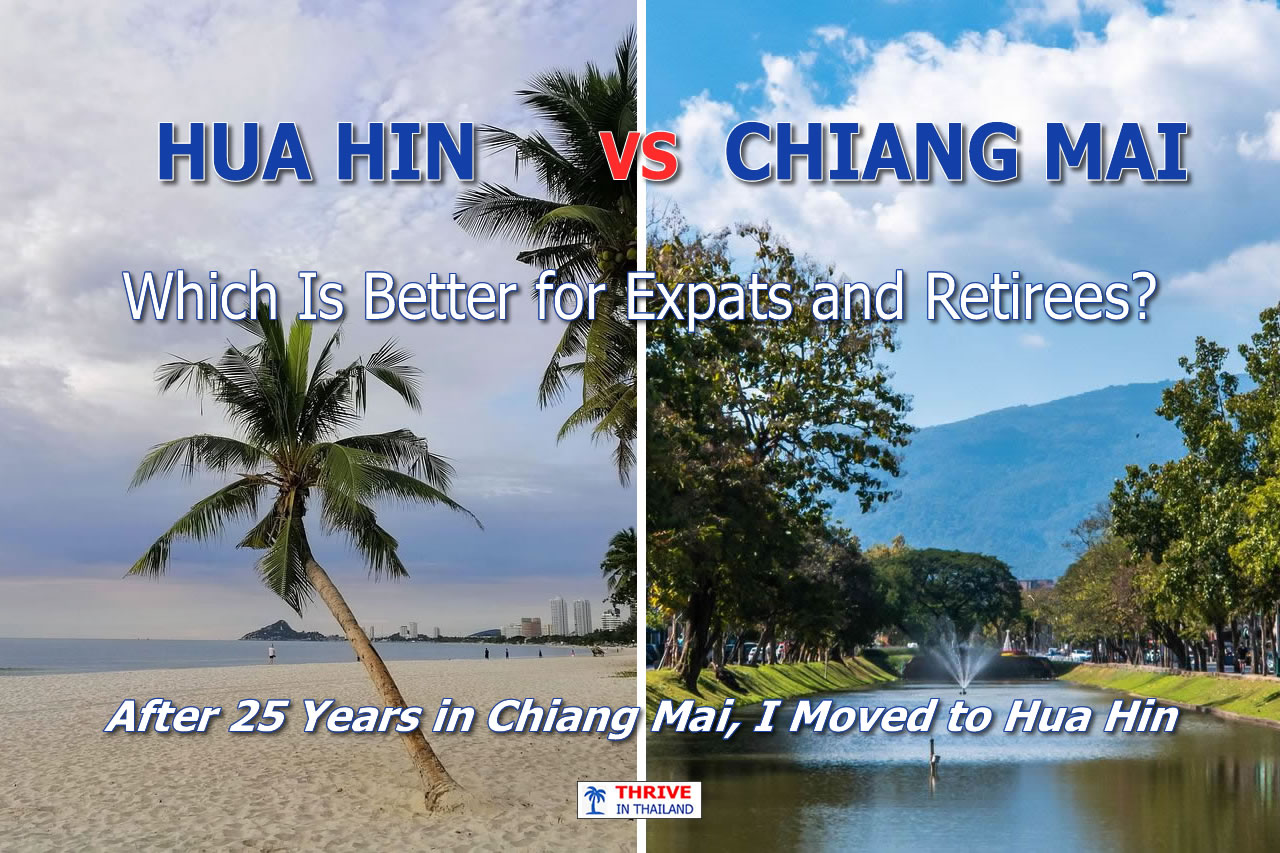
I lived in Chiang Mai for around 25 years before moving to Hua Hin in 2024. During much of that time, I worked in real estate and property development, raised my family and experienced Chiang Mai as a place to live rather than simply somewhere to visit.
Before moving, I expected life on the coast to be more expensive and wondered whether a smaller city such as Hua Hin would feel limiting. Instead, I found the overall cost of living surprisingly similar. Getting around is generally easier, and the slower pace suits the way I want to live now.
That does not make Hua Hin the better choice for everyone. Chiang Mai has more social life, activities, schools, networking opportunities, hospitals and flight connections. Hua Hin offers the beach, a more relaxed atmosphere and an established retirement community. The two cities provide many of the same essentials, but the experience of living in them is very different.
In this comparison, I will look beyond the usual cost figures and destination descriptions. I will compare housing, transport, climate, air quality, healthcare, social life and everyday convenience based on my experience of actually living in both places and explain why I ultimately left Chiang Mai without regretting the move.
Quick Answer: Hua Hin or Chiang Mai?
Choose Chiang Mai if you want the broader range of activities, restaurants, social groups, schools, business opportunities and flight connections. It attracts people across more age groups and lifestyles, while the surrounding mountains and countryside are usually within easy reach.
Choose Hua Hin if you want the beach to be part of everyday life and prefer a slower, more relaxed pace. It has fewer choices than Chiang Mai, but still provides the shopping, restaurants, healthcare and practical services most long-term residents need. Traffic is generally easier, although the city stretches for a considerable distance along the coast.
The overall cost of living is much closer than many comparisons suggest. Hua Hin is not automatically more expensive because it is a coastal resort, while Chiang Mai can become equally costly if you live centrally, eat at upscale restaurants or regularly buy imported products.
Climate may also affect the decision. Chiang Mai has a genuinely cooler period during December and January, but becomes just as hot during the hot season and now experiences severe annual air pollution. Hua Hin remains hot for most of the year but does not suffer pollution on the same scale.
📌 At its simplest, the choice comes down to variety versus ease. Chiang Mai offers the broader package, while Hua Hin offers a simpler and more relaxed lifestyle without leaving me feeling that anything important is missing.
Hua Hin vs Chiang Mai at a Glance
The table below summarises how Hua Hin and Chiang Mai compare across the factors that matter most for long-term living. It provides a quick overview before we examine the costs, climate, housing, healthcare and everyday lifestyle in greater detail.
| Category | Chiang Mai | Hua Hin |
|---|---|---|
| Overall character | A major regional city that still feels relatively approachable | A relaxed coastal resort stretching north–south along the coast |
| Best suited to | Families, active expats, remote workers and people wanting variety | Retirees and anyone wanting beach life and a slower pace |
| Cost of living | Affordable, although central living, imported goods and an upscale lifestyle increase costs | Surprisingly similar overall; coastal living does not automatically make it more expensive |
| Housing | Wide choice of condominiums and houses, with location usually judged from the city centre | Comparable prices overall, with good-value houses but greater importance placed on coastal and inland location |
| Climate and air quality | Cool during December and January, very hot in hot season and affected by severe seasonal air pollution | Hot for most of the year, without a distinct cool season; seasonal pollution occurs, but is far less severe than in Chiang Mai |
| Healthcare | Greater choice of hospitals, specialists and treatment providers | Good range of hospitals and clinics, with Bangkok available for highly specialised treatment |
| Getting around | More Grab and local transport options, but congestion and long traffic-light cycles can make short journeys slow | Longer distances and greater need for a vehicle, but lighter traffic often makes journeys faster and more predictable |
| Travel connections | Excellent domestic and international flight connections | Very limited air services, but convenient overland access to Bangkok |
| Food and shopping | Greater choice of malls, markets, restaurants and international products | Fewer choices, but everything most residents need for comfortable daily life |
| Social life and activities | More events, nightlife, groups and activities for different ages and interests | Enough to do for a relaxed lifestyle, but less variety and excitement |
| Expat community | Larger and more diverse in age, background and lifestyle | Established community with a stronger retiree presence |
| Remote work | Reliable internet and a large café, coworking and digital-nomad scene | Equally suitable infrastructure, but a much smaller remote-work community |
| Families | Clearly stronger for international schools and activities for children | Suitable options are available, but the selection is considerably smaller |
| Natural setting | Mountains, countryside and nature often within around half an hour | Beach and coastal living as part of everyday life |
| Main disadvantage | Severe burning-season pollution and increasingly heavy traffic | Limited flights and potentially too quiet for people seeking a more active lifestyle |
The Main Difference Between Hua Hin and Chiang Mai
The main difference is not that one city has everything while the other lacks essential services. Both provide the shopping, restaurants, healthcare, housing and everyday conveniences needed for comfortable long-term living. Chiang Mai simply offers more choice, while Hua Hin offers a slower and easier way of life.
Chiang Mai serves as the major urban centre of northern Thailand. It has more neighbourhoods, shopping centres, hospitals, international schools, restaurants, events and social groups. It attracts a broad mixture of families, retirees, remote workers, businesspeople and younger expats. Despite this scale, it can still feel more like an approachable town than a large city, with mountains and countryside often reachable within around half an hour.
Hua Hin is smaller and more clearly shaped by its role as a coastal resort. Rather than being organised around one obvious centre, it stretches north–south along the coast and inland along a series of sois. It has fewer choices in most categories, but I have not found anything important missing from daily life. The atmosphere is more relaxed, the foreign community is older on average, and the beach can become part of an ordinary routine rather than an occasional trip.
📌 For me, the difference is best described as more versus enough. Chiang Mai offers more of almost everything, which will matter to people seeking variety, activity and opportunity. Hua Hin offers enough of almost everything, with less traffic, less intensity and a pace of life that may suit people who value ease and a slower pace more than maximum variety.
Cost of Living: Is Chiang Mai Cheaper Than Hua Hin?
Not necessarily. I expected Hua Hin to be more expensive because it is a coastal resort, but that has not been my experience. For comparable lifestyles, the overall cost of living in Hua Hin and Chiang Mai is surprisingly similar.
Both cities can be very affordable if you rent sensibly, eat mostly local food and avoid unnecessary luxury spending. Both can also become expensive if you live in a prime location, go out frequently, eat at upscale restaurants or regularly buy imported products. Chiang Mai offers more choices at every price level, but that does not automatically make everyday life cheaper.
Housing costs also depend heavily on what is being compared. A central Chiang Mai condominium should not be compared with a house far outside Hua Hin, just as a beachfront Hua Hin property should not be compared with accommodation on the outskirts of Chiang Mai. Once location, property type and quality are matched more fairly, the price difference becomes much smaller and Hua Hin may sometimes offer better value.
Online cost comparisons can therefore give a misleading impression when they combine different locations, property types and lifestyles. I would not choose between Hua Hin and Chiang Mai based on the assumption that one is substantially cheaper. The more important question is how you intend to live.
📌 For a broader breakdown of accommodation, food, transport and everyday expenses, see my Cost of Living in Thailand guide, where you can also calculate a budget based on your own lifestyle.
Housing: Condos, Houses and Rental Value
Housing costs in Hua Hin and Chiang Mai are closer than many people expect. I assumed that renting near the coast would carry a substantial premium, but Hua Hin has proved surprisingly affordable. Depending on the type of property and its location, it may even offer better value.
Chiang Mai has a larger and more varied condominium market, as well as houses across its suburban areas. Hua Hin also has plenty of condominiums, but its rental market is particularly attractive for people looking for a house or villa. Good-value homes can be found away from the beachfront and main tourist areas without necessarily being far from shops and services.
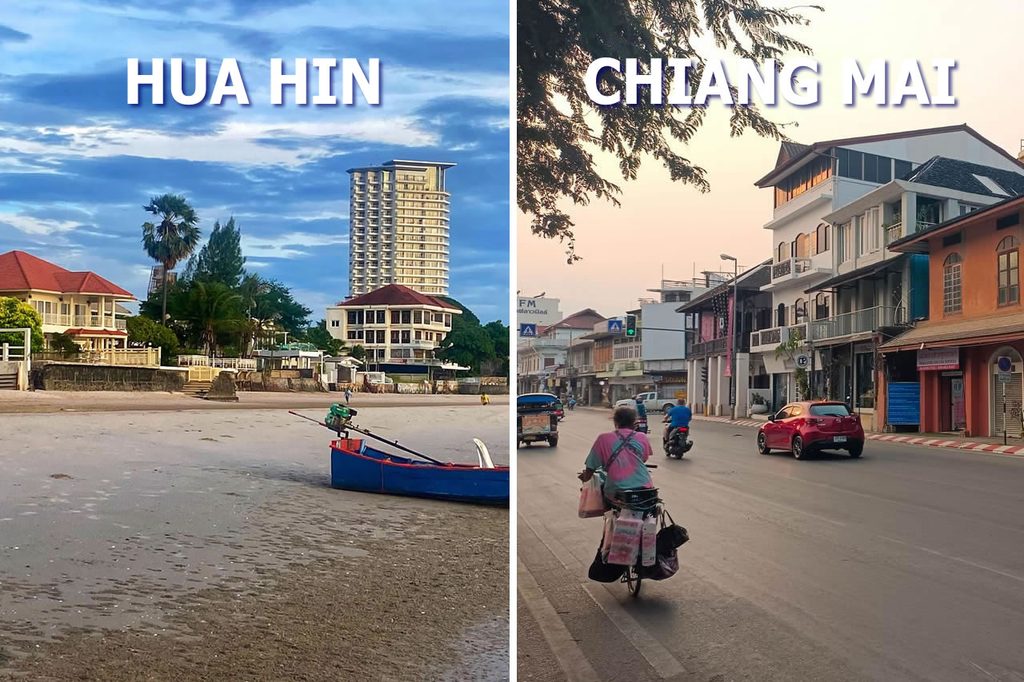
The difficult part is making a fair comparison. Prime central locations in Chiang Mai command higher rents, just as beachfront and central properties do in Hua Hin. Comparing a condominium near the centre of Chiang Mai with a house well inland in Hua Hin may produce an interesting price difference, but it does not compare equivalent lifestyles.
Location also works differently in the two cities. Chiang Mai is organised around a recognisable centre with established neighbourhoods spreading outward. Hua Hin is more linear, extending along the coast and inland along numerous sois. A property may appear close on a map while still requiring regular driving to reach the beach, shopping centres or central Hua Hin.
For that reason, choosing the right location may be more important than finding the lowest advertised rent. Chiang Mai generally offers more condominium choice, while Hua Hin can provide excellent house value. Neither city is the automatic winner, and in both places the right property depends on how you expect to spend your daily life.
📌 For practical advice on deposits, lease terms, inspections and dealing with owners or agents, see my guide to renting a condo or house in Thailand.
Getting Around: Distance Does Not Tell the Whole Story
Hua Hin looks more difficult to navigate on a map. It stretches along the coast and many residential areas extend inland along long sois. Chiang Mai appears more concentrated around a recognisable centre, so it is easy to assume that daily journeys will be shorter and faster there. In practice, that is not always the case.
Chiang Mai has more transport options, including plentiful Grab services and local songthaews. However, the city’s growing traffic, busy intersections and long traffic-light cycles can make even relatively short journeys slow. Having more places nearby is not necessarily helpful if reaching them involves sitting in traffic.
In my experience, driving approximately 5–6 kilometres in Chiang Mai could take about as long as driving 12 kilometres in Hua Hin. This is not a fixed rule, and journey times vary by route and time of day, but it illustrates why distance alone gives a misleading impression.
Hua Hin’s destinations are often farther apart, and owning a car or motorcycle becomes particularly useful when living outside the central area. The advantage is that traffic generally flows more easily, making journey times faster and more predictable. I now travel longer distances but often spend less time getting where I need to go.
📌 Chiang Mai remains the easier city for someone who wants more app-based transport and local alternatives to driving. Hua Hin works particularly well for people with their own vehicle. However, I would not assume that living in Hua Hin necessarily means spending more time on the road.
Climate and Air Quality
Chiang Mai is often described as having a cooler climate than Hua Hin, but that needs qualification. December and January can be genuinely cool and are among the most pleasant months of the year. Outside that relatively short period, however, Chiang Mai is not a cool destination. During the hot season, temperatures can feel every bit as intense as they do in Hua Hin.
Hua Hin remains hot throughout the year and does not have a distinct cool season. Anyone hoping for several months of noticeably cooler weather will therefore prefer Chiang Mai, but the difference is much less significant across the year than many destination comparisons suggest.
The much bigger issue is air quality. Chiang Mai’s burning season has become extremely severe, with smoke and fine-particle pollution affecting daily life for an extended period. Some residents leave the region temporarily, while those who remain may spend more time indoors and rely on air purifiers.
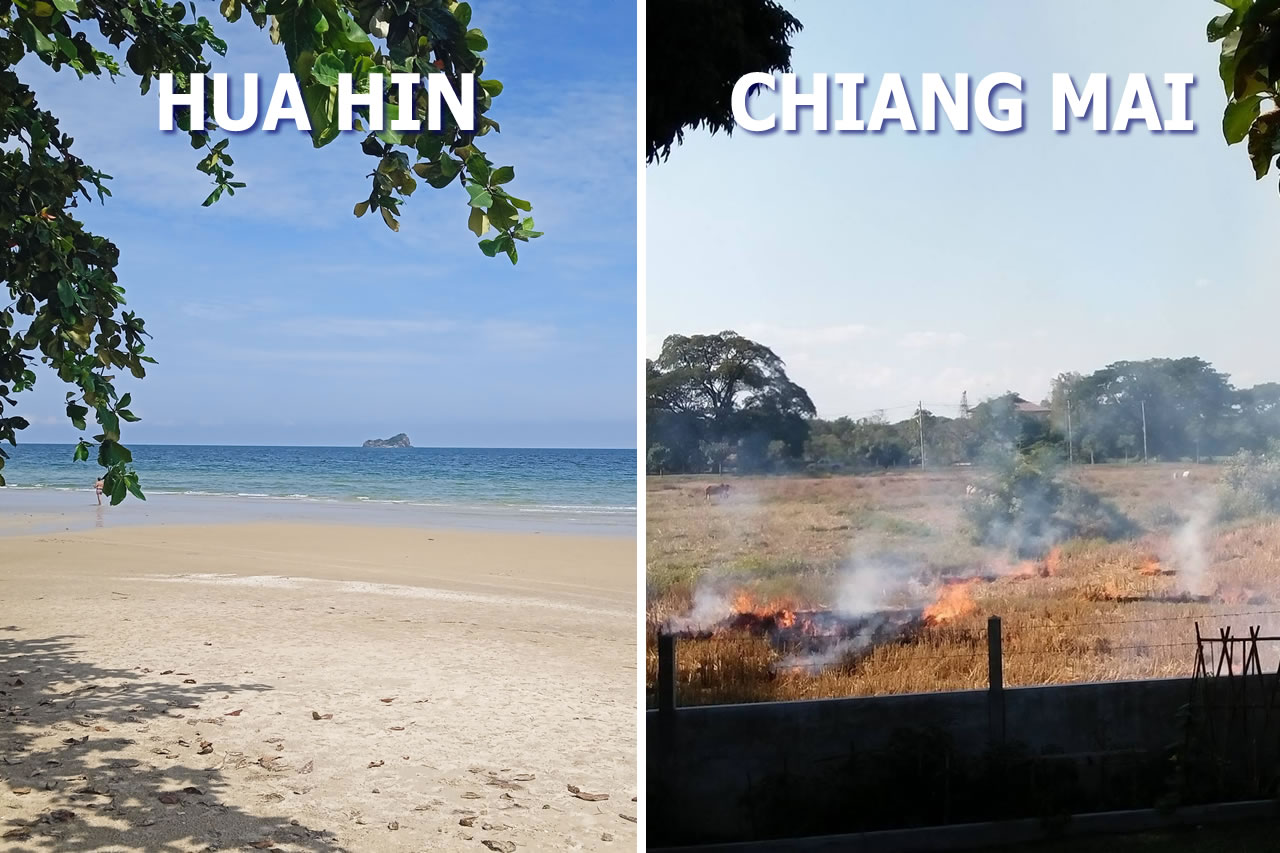
Hua Hin can also experience periods of seasonal air pollution, so it should not be presented as having perfectly clean air throughout the year. In my experience, however, it does not come close to the conditions Chiang Mai now experiences during its worst months.
📌 Air pollution was one of the major reasons I decided to relocate. Chiang Mai wins easily during its short cool season, but for year-round living, Hua Hin’s more consistent air quality has been the more important advantage for me.
Beach Life or Mountains and Countryside?
The natural setting is one of the clearest differences between Hua Hin and Chiang Mai, but the decision involves more than choosing which scenery you prefer. The better question is which environment you are likely to make part of your normal routine.
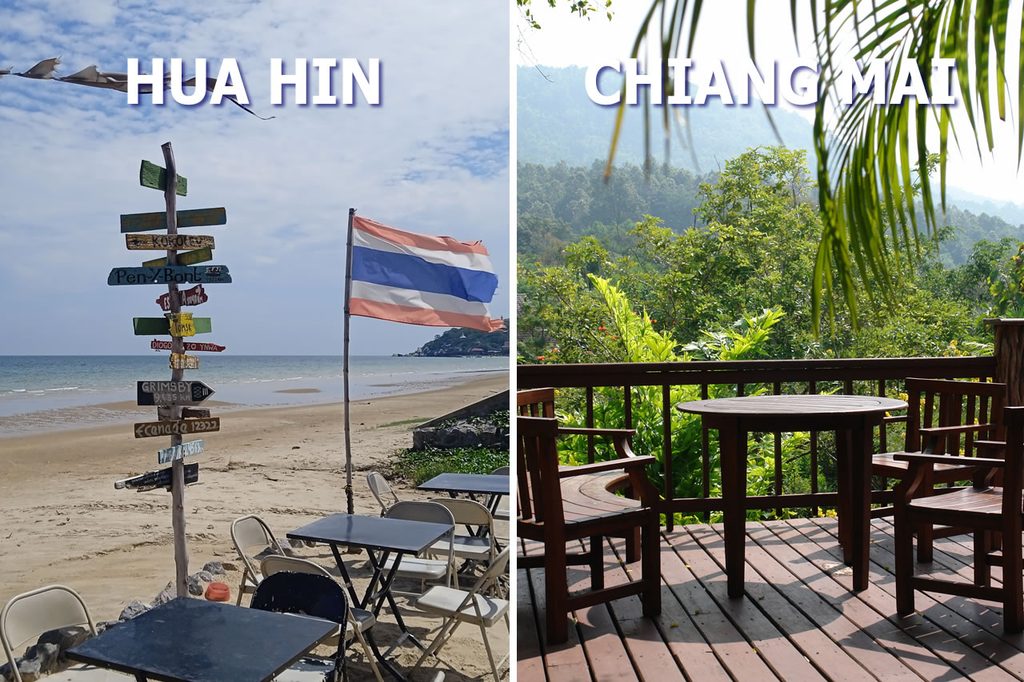
Chiang Mai combines city life with remarkably quick access to mountains and countryside. Depending on where you live, you can leave the built-up areas and reach quieter roads, rural communities and natural surroundings in around half an hour. This balance is an important part of the difficult-to-define “package” that makes the city so attractive to long-term residents. For a closer look at the city and its surroundings, see my Chiang Mai Travel Guide.
Hua Hin offers something Chiang Mai cannot: the opportunity to incorporate the coast into everyday life. The beach does not need to be reserved for holidays or occasional trips. Even residents who do not live directly beside it can reach the sea easily, while further beaches, national parks and quieter coastal communities provide plenty of options for day trips.
📌 Neither setting is inherently better. Chiang Mai suits people who feel most at home around mountains, greenery and northern countryside. Hua Hin suits those who want the sea nearby and enjoy the atmosphere of coastal living. The deciding factor should be which surroundings you will genuinely use rather than which sounds more appealing in theory.
Everyday Life, Food and Shopping
Chiang Mai has a noticeably larger selection of shopping centres, markets, restaurants, cafés and specialist stores. It also has a wider choice of international food and entertainment. For someone who enjoys continually trying new places or wants access to a particular niche product or service, that greater variety is a genuine advantage.
Hua Hin has fewer options, but I have not found that restrictive in daily life. It has modern shopping centres, supermarkets, local markets, international restaurants and plenty of places to eat Thai food and seafood. I do not miss anything from Chiang Mai; I simply have fewer alternatives to choose from.
Both cities attract large numbers of tourists, long-stay visitors and foreign residents. In either place, it is easy to leave the main visitor areas and find ordinary Thai neighbourhoods, markets and restaurants. Hua Hin nevertheless feels more like a resort because it is smaller, follows the coastline and has the beach at the centre of its identity.
The rhythm of the two places is also different. Hua Hin is usually calmer during the week but becomes noticeably busier on weekends and long weekends, when many Thai visitors arrive from Bangkok. Chiang Mai experiences seasonal increases in tourism and particularly large crowds during major festivals such as Songkran and Loy Krathong.
📌 For everyday convenience, both cities work well. Chiang Mai is better for people who enjoy having the widest possible range of places to go, while Hua Hin makes ordinary life feel less busy and more relaxed.
Social Life and Things to Do
Chiang Mai clearly offers the larger and more varied social scene. Its foreign community includes families, retirees, remote workers, businesspeople, students and younger expats. That mixture supports a wider range of events, interest groups, nightlife, organised activities and opportunities to meet people with similar interests.
The city also provides more opportunities for professional networking and collaboration. For someone building a business, working remotely or looking for an active social calendar, Chiang Mai offers an environment that Hua Hin cannot match at the same scale.
Hua Hin attracts an older foreign population and has a well-established retirement community. Its social scene is smaller and less varied, but that does not mean it is difficult to meet people. In my experience, anyone willing to make an effort can build a social circle in either city. I now have a small group of people in Hua Hin and do not feel that I have lost anything socially by moving.
📌 The question is therefore not whether Hua Hin has enough to do, but how much activity someone wants. It offers plenty for a relaxed lifestyle, while Chiang Mai is the clear winner for people seeking greater variety, nightlife, networking and excitement.
Healthcare and Practical Services
Chiang Mai has the advantage in healthcare choice. It has a larger number of private and government hospitals, specialist clinics and treatment providers. Having several hospitals to choose from is convenient, particularly when seeking a second opinion or looking for a doctor in a specific field.
Hua Hin nevertheless provides considerably more healthcare than its smaller size might suggest. It has Bangkok Hospital Hua Hin, a government hospital and additional hospitals and clinics. Routine care and many common treatments can be handled locally, while residents may need to travel to Bangkok for highly specialised care.
For most retirees, healthcare should therefore not be a reason to rule out Hua Hin. Chiang Mai offers greater depth and more alternatives, but Hua Hin covers the needs that most residents are likely to encounter.
There is little meaningful difference in basic everyday infrastructure. Both cities provide reliable home internet, delivery services, modern utilities and everything needed to work online. Chiang Mai, however, has far more coworking spaces and a much larger digital-nomad community. Hua Hin is well suited to working from home, but offers fewer dedicated workspaces and networking opportunities.
📌 For a closer look at local hospitals, specialist care and long-term care options, see my Healthcare & Assisted Living in Hua Hin guide.
Airports and Travel Connections
For anyone who flies regularly, Chiang Mai wins this comparison by a considerable margin. Chiang Mai International Airport provides direct connections to Bangkok and numerous other domestic and international destinations. Its route network makes both travel within Thailand and trips abroad considerably easier.
Hua Hin Airport cannot realistically compete. At the time of writing, its only regular direct connection is Chiang Mai. The route is convenient for travelling between the two cities, but it does not provide Hua Hin residents with a meaningful flight network.
Hua Hin’s advantage is its relative proximity to Bangkok. The capital can be reached by road or rail, providing access to both Suvarnabhumi and Don Mueang airports. However, the overland journey still adds several hours to a flight and requires more planning than travelling from Chiang Mai’s local airport.
📌 For occasional travel, Hua Hin’s access to Bangkok may be sufficient. Frequent domestic or international travellers will find Chiang Mai substantially more convenient.
Which City Is Better for Families?
Chiang Mai is clearly the stronger choice for most families. It has a wider selection of international schools and more organised activities for children, giving parents greater flexibility when choosing an education and building a routine around their children’s interests.
Hua Hin has international and bilingual education options and may appeal to families who prefer a quieter coastal environment. However, the smaller selection means that choosing a school may also determine where the family needs to live and how far they travel each day.
For retirees and couples without school-age children, this difference may have little importance. For families planning a long-term move, Chiang Mai’s broader educational and recreational offering is a significant advantage.
Who Should Choose Chiang Mai?
Chiang Mai is likely to be the better choice if you want:
- A larger and more varied social scene
- More restaurants, shopping, events and entertainment
- Stronger networking and business opportunities
- A wider choice of international schools and activities for children
- Convenient domestic and international flights
- Easy access to mountains and northern countryside
- A genuine cool period during December and January
- More hospitals, specialists and professional services
Chiang Mai is particularly well suited to families, active expats, remote workers and people who enjoy having many options available. Its attraction is not based on one outstanding feature, but on the combination of city conveniences, culture, social life, nature and opportunity.
📌 The main compromise is accepting heavier traffic and the severe annual burning season. For anyone sensitive to air pollution—or unable to leave during the worst months—that disadvantage may outweigh many of the city’s strengths.
Who Should Choose Hua Hin?
Hua Hin is likely to be the better choice if you want:
- The beach to be part of everyday life
- A slower and more relaxed pace
- Lighter traffic and more predictable journey times
- Good-value houses and villas
- An established retirement community
- Access to Bangkok without living in the capital
- Less severe seasonal air pollution than Chiang Mai
- Enough shopping, dining, healthcare and services without needing maximum choice
Hua Hin is particularly well suited to retirees, couples and people whose priorities have shifted from constant variety towards comfort, ease and a calmer routine. It offers fewer activities and social options than Chiang Mai, but still provides everything most residents need for a comfortable life.
📌 The main compromises are the year-round heat, limited flight connections and greater need for personal transport outside the central area. People seeking extensive nightlife, frequent events or a large younger expat community may eventually find Hua Hin too quiet.
Why I Left Chiang Mai After 25 Years
At some point, I asked myself what I was actually doing in Chiang Mai and why I was still there. When I looked honestly at my routine, I realised that I spent most of my time at home, went into town perhaps once a week, met with a small circle of friends and went to the gym.
I was no longer making much use of the things Chiang Mai offered in greater abundance. I had already visited the attractions, explored the surrounding area and experienced the festivals. More restaurants, events and entertainment had little practical value to me when I rarely used them, while the traffic and annual air pollution had become increasingly difficult to ignore.
My daughter was the strongest reason for remaining in Chiang Mai. When she spent a year in Australia, however, it made me think more seriously about the future. She had her own life to build, and there was no guarantee that she would always remain in Chiang Mai or even in Thailand.
That left my friends as the main thing I would miss. I valued those friendships, but I also knew that I had never found it particularly difficult to meet people. Since moving, I have built a small social circle in Hua Hin and have not felt isolated. My daughter and friends also visit me here, and I occasionally return to Chiang Mai. The direct flight between the two cities makes staying connected relatively easy.
Leaving Chiang Mai was therefore not a rejection of the city. It had given me a home for 25 years and still offered many advantages. I had simply reached a stage at which I was no longer using most of them.
📌 Hua Hin matched the life I was actually living rather than the life Chiang Mai made possible. It offered the beach, cleaner air, easier journeys and a slower pace without requiring me to give up anything that still mattered to my daily routine.

Final Verdict: Do I Regret Moving to Hua Hin?
I do not regret leaving Chiang Mai or moving to Hua Hin. If anything, Hua Hin has surprised me positively. It is more affordable than I expected, provides everything I need and makes ordinary daily life feel easier. I feel comfortable and happy here.
Chiang Mai may win more individual categories, particularly for variety, education, healthcare and travel connections. For families, frequent travellers and people seeking a more active lifestyle, it will often be the better choice.
However, choosing where to live is not about counting how many categories each city wins. It is about deciding which advantages you will genuinely use and which disadvantages will affect you most. Chiang Mai’s greater variety no longer added much to my life, while its traffic and air pollution did. Hua Hin’s beach, slower pace and easier journeys now matter more to me than having the widest possible selection.
📌 My conclusion is simple: Chiang Mai offers the broader package, but Hua Hin offers the lifestyle I now prefer. Neither city is universally better. The right choice depends on your stage of life, how active you want to be and whether you would rather have more possibilities or a more relaxed everyday routine.

Hua Hin Hub
Explore my collection of Hua Hin guides covering living, healthcare, costs, accommodation, retirement, and everyday life on Thailand’s Gulf Coast.
💬 Have you lived in Hua Hin or Chiang Mai? Share your experience in the comments. I’d be interested to hear how the two compare for you.