


Hua Hin has long been one of Thailand’s most popular places for retirees and long-term expats. The town offers a slower pace than Bangkok, easy access to the beach, a sizeable foreign community, and enough modern conveniences to make daily life comfortable without feeling overwhelming.
But for many people planning a long-term move, healthcare eventually becomes just as important as housing, cost of living, or lifestyle. It is one thing to enjoy Hua Hin for a holiday or a relaxed retirement. It is another to know what support is available if you need regular medical care, help at home, assisted living, or full-time nursing support later in life.
The good news is that Hua Hin has a solid healthcare base for a town of its size, including private hospitals, public medical services, specialist clinics, pharmacies, home care providers, and a growing number of retirement and assisted living options. At the same time, it is important to understand the limits. For complex treatment or highly specialized care, Bangkok may still be the better choice.
This guide explains what healthcare and assisted living look like in Hua Hin, who the different care options are suitable for, what to consider before choosing a facility or service, and how to plan ahead if you are thinking about retiring here long-term.
Why Many Retirees Choose Hua Hin
A Relaxed Lifestyle with Modern Healthcare
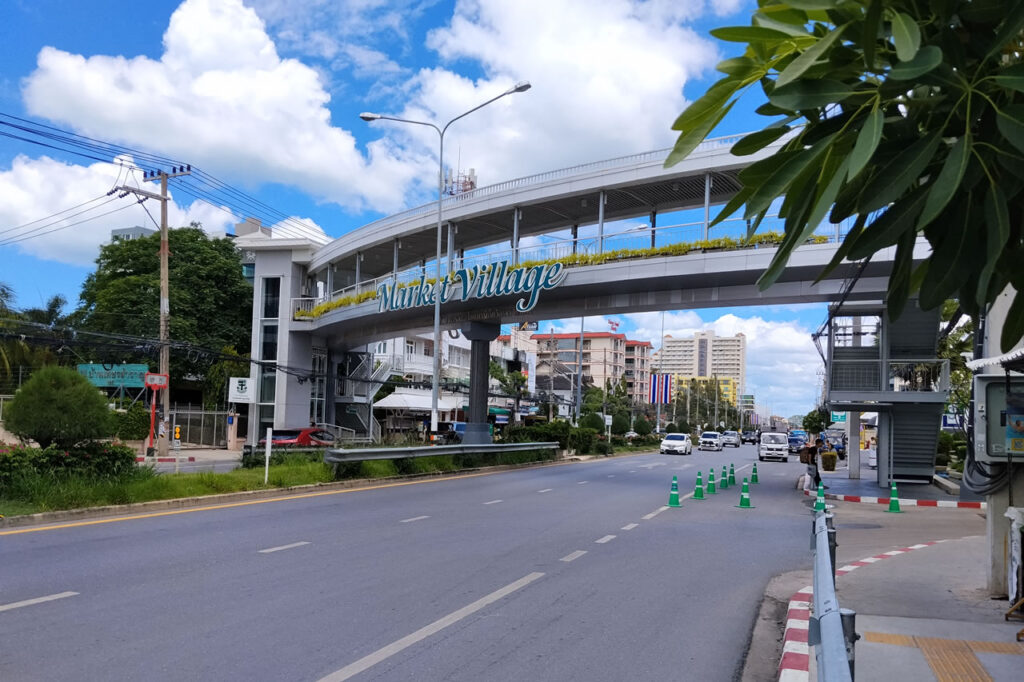
Hua Hin has been attracting retirees for decades, and healthcare is only part of the story. For many people, the appeal begins with the lifestyle. Compared to Bangkok, daily life is generally quieter, less congested, and easier to navigate. The town is large enough to offer modern conveniences, shopping centers, international restaurants, and private hospitals, yet small enough that most destinations remain within a short drive.
The coastal setting is another major draw. Many retirees appreciate the ability to enjoy morning walks along the beach, spend time outdoors throughout the year, and maintain an active lifestyle without the extremes of a large city. Hua Hin also has a well-established expat community, making it easier for newcomers to build social connections and find practical support when settling into life in Thailand.
Perhaps just as importantly, Hua Hin offers a sense of balance. Residents can enjoy a relatively relaxed environment while still having access to many of the services they may need as they grow older. This combination of lifestyle, convenience, and healthcare access is one of the main reasons the town continues to attract retirees from around the world.
Healthcare as Part of the Decision
When people first start researching retirement in Thailand, healthcare is not always at the top of their list. Most attention tends to focus on visas, housing, cost of living, and whether a location offers the lifestyle they are looking for.
Over time, however, healthcare often becomes one of the most important factors in choosing where to live. Regular check-ups, specialist consultations, prescription medication, emergency services, and long-term care options become increasingly relevant as we age. Even retirees who are currently healthy may want reassurance that quality medical support is available if circumstances change in the future.
This is one area where Hua Hin performs well. While it cannot match Bangkok’s vast number of hospitals and specialists, it offers a level of healthcare that many retirees find more than adequate for everyday needs. For more complex cases, Bangkok remains close enough to serve as a practical backup option, giving residents access to some of Thailand’s most advanced medical facilities without having to live in the capital full-time.
Healthcare & Retirement Snapshot
| Factor | Why It Matters |
|---|---|
| Private Hospitals | Access to modern medical care and English-speaking staff. |
| Public Healthcare | Lower-cost treatment options for routine care and emergencies. |
| Specialist Services | Ongoing support for age-related conditions and chronic health issues. |
| Home Care Providers | Allows retirees to receive assistance while remaining in their own home. |
| Retirement Community | Provides social connections, activities, and informal support networks. |
| Bangkok Access | Advanced medical treatment and specialist hospitals are within a few hours. |
| Lifestyle | A relaxed environment that supports healthy and active aging. |
Understanding Healthcare in Hua Hin
One of the reasons Hua Hin remains so popular with retirees is that healthcare is generally easy to access. While it is not a major city like Bangkok, the town offers a good mix of public and private medical services that can comfortably handle most day-to-day healthcare needs.
Residents have access to hospitals, specialist clinics, dental practices, physiotherapy centers, pharmacies, diagnostic services, and home-care providers. Whether you need a routine check-up, ongoing treatment for a chronic condition, or emergency medical attention, most services can be found locally without the need to travel far.
For many retirees, this strikes an ideal balance. Hua Hin is large enough to support a modern healthcare system but small enough that appointments, hospital visits, and everyday errands are often less stressful than in larger cities.
That said, it is important to understand what Hua Hin can and cannot provide. Routine medical care, diagnostics, minor procedures, rehabilitation, and many specialist services are readily available. However, for highly complex surgeries, advanced cancer treatment, organ transplants, or certain specialized medical conditions, patients are often referred to Bangkok, where Thailand’s largest and most advanced hospitals are located.
Fortunately, Bangkok is only a few hours away by road, allowing many retirees to enjoy Hua Hin’s relaxed lifestyle while still having access to world-class medical facilities when needed.
What Healthcare Services Are Available?
Most retirees living in Hua Hin will have access to:
- Private hospitals with English-speaking staff
- Public hospitals for lower-cost treatment
- Specialist medical clinics
- Dental clinics
- Eye care and vision services
- Physiotherapy and rehabilitation centers
- Diagnostic imaging and laboratory services
- Pharmacies and prescription medication
- Home nursing and caregiver services
- Emergency medical care
📌 For many expats, the healthcare infrastructure available in Hua Hin is more extensive than they initially expect from a coastal town of its size. This combination of accessibility, affordability, and quality is one of the reasons many retirees feel comfortable making Hua Hin their long-term home.
New to healthcare in Thailand?
Before comparing hospitals, insurance options, and healthcare providers in Hua Hin, it helps to understand how Thailand’s healthcare system works for foreigners.
Read: Thailand Healthcare System for Foreigners
Hospitals in Hua Hin
For most retirees and long-term residents, hospitals are often the first thing that comes to mind when evaluating healthcare in a new location. Fortunately, Hua Hin offers several well-established hospitals that provide everything from routine consultations and diagnostic testing to emergency treatment and specialist care.
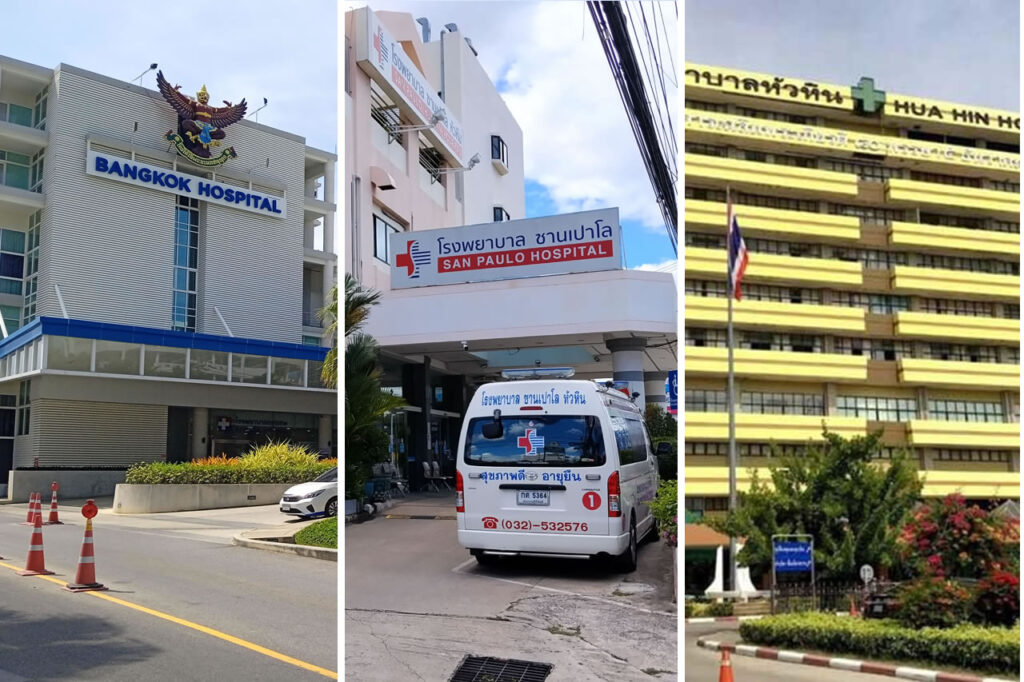
Most expats living in Hua Hin rely on a combination of private hospitals for routine healthcare and specialist appointments, while some also use public facilities for certain treatments or emergencies. The best choice often depends on your budget, insurance coverage, and personal preferences.
Bangkok Hospital Hua Hin
✅ For many foreigners, Bangkok Hospital Hua Hin is the first choice for private healthcare in the area.
Part of the larger Bangkok Hospital network, the facility is designed to serve both Thai and international patients. English-speaking staff are widely available, the hospital maintains modern equipment, and the overall experience is often familiar to patients coming from Europe, Australia, or North America.
Services include:
- General medical consultations
- Specialist appointments
- Health screenings
- Diagnostic imaging
- Emergency treatment
- Surgery
- Rehabilitation services
📌 Many retirees choose Bangkok Hospital Hua Hin because of its convenience, international standards, and strong reputation among the local expat community.
San Paulo Hospital
✅ Located in central Hua Hin, San Paulo Hospital is another popular private healthcare provider.
The hospital has served the community for many years and is often considered a practical alternative to Bangkok Hospital. Many residents use it for routine consultations, diagnostics, outpatient care, and specialist appointments.
Advantages include:
- Central location
- Generally lower costs than some international hospitals
- Good range of outpatient services
- English-speaking staff in key departments
📌 For many expats, San Paulo Hospital provides a comfortable balance between affordability and quality healthcare.
Hua Hin Hospital
✅ Hua Hin Hospital is the town’s main public hospital and serves a large local population.
As with many public hospitals in Thailand, treatment costs are significantly lower than at private facilities. However, patients may experience longer waiting times and fewer international services compared to private hospitals.
The hospital offers:
- Emergency care
- Inpatient treatment
- Specialist clinics
- Surgical services
- Maternity care
- General healthcare services
📌 Some expats use Hua Hin Hospital regularly, while others prefer private facilities for routine care and reserve public hospitals for specific situations.
Major Hospitals in Hua Hin at a Glance
| Hospital | Type | Best For |
|---|---|---|
| Bangkok Hospital Hua Hin | Private Hospital | International-standard care, specialists, surgery, and English-speaking services |
| San Paulo Hospital | Private Hospital | Routine medical care, specialist consultations, and convenient central location |
| Hua Hin Hospital | Government Hospital | Lower-cost treatment, emergencies, and general healthcare services |
Emergency Medical Care
✅ Hua Hin is generally well-equipped to handle common medical emergencies.
Private hospitals provide emergency departments, ambulance services, and access to specialist physicians. Public emergency services are also available throughout the area.
As with anywhere in Thailand, having adequate health insurance can make emergency treatment significantly smoother, particularly at private hospitals where upfront payment may otherwise be required.
When Bangkok May Be the Better Option
One of the strengths of living in Hua Hin is that residents have access to local healthcare while remaining relatively close to Bangkok.
In some situations, doctors may recommend treatment in the capital, particularly for:
- Complex heart procedures
- Advanced cancer treatment
- Organ transplants
- Rare medical conditions
- Highly specialized surgery
For most routine healthcare needs, retirees can comfortably rely on Hua Hin’s local medical infrastructure. However, knowing that some of Thailand’s best hospitals are only a few hours away provides additional peace of mind for many long-term residents.
📌 This balance between local convenience and access to advanced care is one of the reasons healthcare is often viewed as a major advantage of retiring in Hua Hin.
Specialist Care & Outpatient Services
While hospitals are an important part of the healthcare system, most retirees spend far more time visiting outpatient clinics, specialists, dentists, and pharmacies than they do staying in hospital. Fortunately, Hua Hin offers a wide range of healthcare services that can support everyday medical needs and ongoing treatment for chronic conditions.
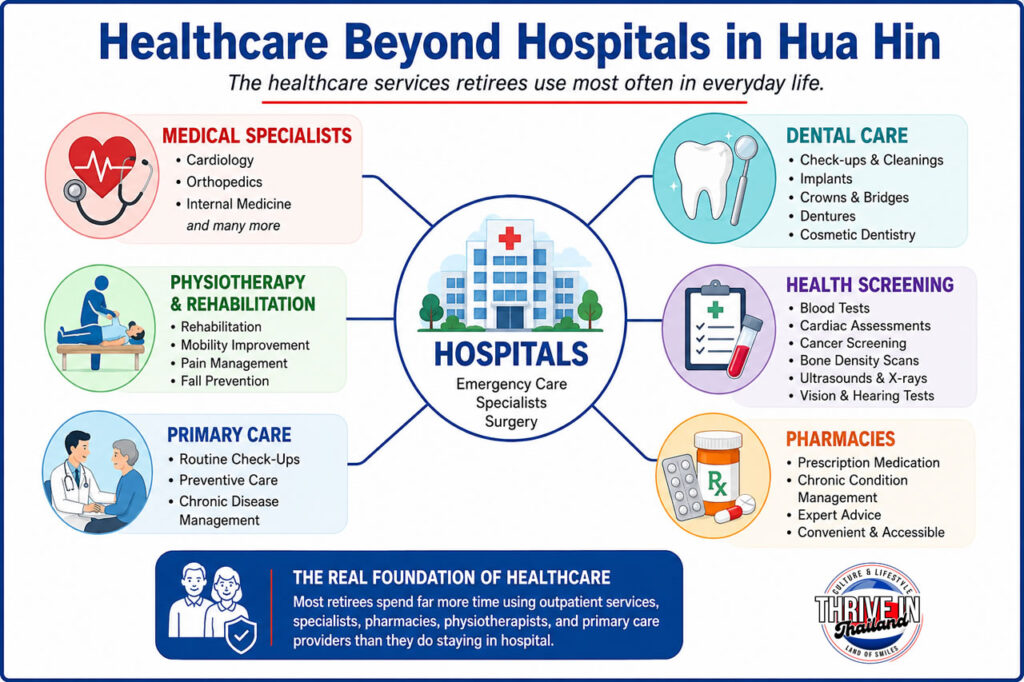
For many residents, these services provide the real foundation of healthcare in Hua Hin. Routine check-ups, prescription renewals, physiotherapy appointments, and specialist consultations can often be arranged quickly and without the long waiting times commonly associated with public healthcare systems in some Western countries.
In addition to hospitals, Hua Hin has a growing network of specialist clinics, diagnostic centers, physiotherapists, dental practices, and outpatient medical providers. One example is Be Well Medical Centre, which has become particularly popular among expats and retirees for primary care, preventive medicine, chronic disease management, and routine healthcare services, including dental care.
Medical Specialists
As people age, access to specialist care often becomes increasingly important. Many retirees require ongoing monitoring or treatment for conditions such as high blood pressure, diabetes, heart disease, arthritis, or eye problems.
Hua Hin offers access to a variety of specialists, including:
- Cardiology
- Orthopedics
- Internal medicine
- Neurology
- Dermatology
- Gastroenterology
- Urology
- Ophthalmology (eye care)
- Ear, nose, and throat (ENT)
📌 Many specialists practice through the town’s private hospitals, while others operate independent clinics throughout Hua Hin.
Dental Care
Dental care is one area where Thailand has developed a particularly strong reputation among foreigners.
Hua Hin has numerous modern dental clinics offering services ranging from routine cleanings and fillings to crowns, implants, dentures, and cosmetic procedures. Many clinics cater to international patients and employ English-speaking staff.
📌 For retirees, regular dental care can play an important role in maintaining overall health and quality of life, making easy access to these services a valuable advantage.
Physiotherapy & Rehabilitation
Physiotherapy is often overlooked until it becomes necessary.
Whether recovering from surgery, managing chronic back pain, improving mobility, or rehabilitating after an injury, Hua Hin offers several physiotherapy and rehabilitation providers. Services are available through hospitals as well as independent clinics.
Common treatments include:
- Post-surgical rehabilitation
- Joint and muscle therapy
- Mobility improvement
- Sports injury recovery
- Balance and fall-prevention programs
📌 For older adults hoping to maintain an active lifestyle, physiotherapy can be an important part of healthy aging.
Health Screening Programs
One of the benefits of healthcare in Thailand is the availability of comprehensive health screening packages.
Private hospitals regularly offer screening programs that can include:
- Blood tests
- Cardiac assessments
- Cancer screening
- Ultrasounds
- X-rays
- Bone density scans
- Vision and hearing tests
📌 Many retirees take advantage of annual health screenings as a proactive way to monitor their health and identify potential issues before they become serious problems.
Pharmacies & Prescription Medication
Pharmacies are widely available throughout Hua Hin and are often one of the most convenient parts of the healthcare system.
Many common medications can be purchased directly from pharmacies without a doctor’s visit, although prescription requirements vary depending on the medication involved. Pharmacists are generally knowledgeable and can often provide basic advice for minor health concerns.
For retirees managing chronic conditions, access to pharmacies is rarely a challenge in Hua Hin. Most commonly prescribed medications are readily available, although some specialized medications may occasionally need to be ordered or sourced through hospitals.
📌 Related Guide: Prescription Medication in Thailand: A Complete Guide for Expats
A Healthcare System Built Around Everyday Needs
One reason many retirees feel comfortable living in Hua Hin is that healthcare is not limited to hospitals alone. The town provides access to the routine services people use most often, from specialist consultations and dental care to physiotherapy and prescription medication.
📌 For the majority of residents, these everyday healthcare services form the backbone of staying healthy, active, and independent throughout retirement.
Health Insurance Considerations
Good healthcare is only part of the equation. The other consideration is how that care will be paid for.
Many retirees arrive in Thailand healthy and active, with little expectation of needing significant medical treatment. While that may be true initially, healthcare needs often change over time. A routine hospital visit, unexpected surgery, or ongoing treatment for a chronic condition can become expensive without adequate insurance or financial planning.
For anyone considering a long-term future in Hua Hin, health insurance is a topic worth addressing before it becomes necessary.
Why Insurance Becomes More Important as You Age
As we get older, the likelihood of needing medical care naturally increases. Regular check-ups, specialist consultations, prescription medications, diagnostic testing, and occasional hospital admissions become more common.
Even retirees who are currently in excellent health may eventually face situations such as:
- Heart-related conditions
- Diabetes management
- Joint replacements
- Cancer treatment
- Stroke rehabilitation
- Long-term nursing care
While healthcare costs in Thailand are often lower than in many Western countries, private treatment can still become expensive, particularly when hospitalization is involved.
📌 For this reason, many retirees choose to maintain private health insurance for as long as possible.
Common Challenges for Older Expats
Obtaining health insurance becomes more complicated with age.
Some of the challenges retirees may encounter include:
- Higher premiums
- Age limits for new applications
- Reduced coverage options
- Pre-existing condition exclusions
- Waiting periods for certain treatments
📌 These challenges are one reason many long-term expats recommend arranging suitable coverage before health issues begin to develop.
For representative premium ranges at ages 60, 65, 70 and 75, together with information about entry-age limits, renewability, pre-existing conditions and obtaining new coverage after 70, see my guide to health insurance in Thailand over 60.
Self-Funding vs Health Insurance
Some retirees choose to self-fund their healthcare rather than maintain private insurance.
This approach may work for individuals who:
- Have substantial savings
- Can comfortably cover major medical expenses
- Understand the financial risks involved
Others prefer the peace of mind that comes with comprehensive insurance coverage, particularly when it comes to hospital admissions, surgery, or emergency treatment.
📌 There is no universal solution. The right approach depends on your age, health, financial situation, and personal tolerance for risk.
Healthcare Costs Are Only Part of the Picture
When discussing healthcare planning, many people focus entirely on hospital bills. However, long-term care can sometimes become a larger financial consideration.
For example:
- Home caregivers
- Assisted living facilities
- Rehabilitation services
- Long-term nursing support
may continue for months or even years.
Planning for these possibilities early can provide more flexibility later and help avoid difficult decisions during a medical crisis.
📌 Related Guide: Thailand Health Insurance Guide
Looking Beyond Hospitals
One of the reasons healthcare planning is so important is that retirement care often extends beyond hospitals and doctor’s appointments. Many people eventually require varying levels of assistance with daily living, even if they remain relatively healthy.
📌 Understanding the different types of support available can make it easier to plan for the future and choose the option that best matches your needs.
Understanding Long-Term Care Options
When people hear terms such as assisted living, retirement community, or nursing home, they are often used interchangeably. In reality, these services provide very different levels of support and are designed for people with different needs.
Understanding these distinctions is important because the type of care that suits a healthy and active retiree may be very different from what is needed later in life.
Rather than viewing long-term care as a single solution, it is often more helpful to think of it as a continuum. As circumstances change, people may move from independent living to assisted living, and eventually to more intensive nursing care if required.
Independent Living
Independent living is the option most retirees in Hua Hin choose.
People in this category are generally active, able to manage their own daily routines, and require little or no assistance. They may live in a condominium, a private villa, or a retirement-oriented community designed for older residents.
The main advantages include:
- Complete independence
- Privacy
- Flexibility
- Lower ongoing care costs
- Ability to maintain an active lifestyle
Many retirees remain in this stage for years or even decades.
📌 However, independent living also requires some planning. Tasks such as driving, shopping, cooking, home maintenance, and managing medical appointments remain the responsibility of the individual.
Assisted Living
Assisted living bridges the gap between complete independence and full-time nursing care.

Residents continue to live relatively independently but receive support with certain aspects of daily life. The exact services vary between facilities, but assistance may include:
- Medication management
- Housekeeping
- Meal preparation
- Personal care
- Transportation assistance
- Health monitoring
- Emergency response support
Assisted living is often suitable for people who remain active and socially engaged but would benefit from some additional help and peace of mind.
📌 For many retirees, assisted living provides a way to maintain independence while reducing some of the practical challenges that can arise with age.
Nursing Care
Nursing care is designed for individuals who require a much higher level of medical or personal support.
This may include people living with:
- Advanced mobility limitations
- Dementia or Alzheimer’s disease
- Chronic medical conditions
- Significant disabilities
- Recovery needs following major illness or surgery
Services typically include:
- 24-hour supervision
- Nursing support
- Medication administration
- Rehabilitation assistance
- Personal care
- Medical monitoring
📌 While many retirees hope they will never require this level of support, understanding what options are available can help families prepare for future healthcare needs.
Care Needs Often Change Gradually
One of the biggest misconceptions about retirement care is that people suddenly move from complete independence to full-time nursing support.
In reality, changes often happen gradually.
A person may begin by hiring occasional help with housekeeping, later add a part-time caregiver, eventually move into an assisted living environment, and only require nursing care many years later.
📌 This is one reason planning ahead can be so valuable. Understanding the different levels of care available in Hua Hin allows retirees and their families to make informed decisions before a crisis occurs.
Independent Living in Hua Hin
For most retirees, independent living is not only the starting point but also the long-term goal. Many people move to Hua Hin precisely because it allows them to enjoy an active and independent lifestyle while still having access to healthcare and support services if needed in the future.
The town is well suited to retirees who want to maintain their freedom while benefiting from a relaxed environment, modern conveniences, and a strong sense of community.
Who Independent Living Suits
Independent living is generally appropriate for people who:
- Manage their own daily activities
- Drive or arrange their own transportation
- Handle their own finances and appointments
- Require little or no personal care assistance
- Want to maintain an active lifestyle
This describes the majority of expats and retirees currently living in Hua Hin.
📌 Many residents continue to live independently well into their seventies and eighties, particularly when they remain physically active and have access to good healthcare.
Typical Housing Options
Hua Hin offers several housing choices for independent retirees.
Condominiums
Condominiums are popular with both single retirees and couples.
Advantages often include:
- Lower maintenance requirements
- Security services
- Shared facilities such as pools and gyms
- Convenient locations near shops, restaurants, and hospitals
📌 For retirees who want a simple, lock-up-and-leave lifestyle, a condo can be an attractive option.
Private Houses and Villas
Others prefer the additional space and privacy that a house or villa provides.
Benefits may include:
- Larger living areas
- Private gardens
- Space for visiting family
- Greater privacy
📌 The trade-off is that houses generally require more maintenance and are often located further from central services.
Retirement-Oriented Communities
Some retirees choose communities specifically designed with older residents in mind.
These developments may offer:
- Community facilities
- Organized activities
- Maintenance services
- Security
- Easy access to healthcare providers
📌 The level of support varies considerably between communities, so it is important to understand exactly what services are included.
One example is Senior Residences by Dhevan Dara, a retirement-focused community that combines independent living with services and facilities aimed at long-term residents. The community is designed for active retirees who want to maintain their independence while living in an environment tailored to the needs of older adults.
Communities such as these often appeal to retirees who value convenience, security, and access to support services without giving up the freedom that comes with living independently.
📌 It is important to remember that retirement communities can differ significantly in terms of services, facilities, healthcare support, and ongoing costs. Visiting in person and understanding exactly what is included is always advisable before making a long-term commitment.
The Advantages of Staying Independent
One of the reasons independent living remains so popular is that it allows retirees to continue living life on their own terms.
Many people appreciate the ability to:
- Maintain established routines
- Stay socially active
- Travel freely
- Choose their own healthcare providers
- Control their own schedules
📌 For retirees moving to Thailand to enjoy greater freedom and flexibility, preserving independence is often a major priority.
Challenges to Consider
While independent living works well for many people, it is worth thinking about how circumstances may change over time.
Questions worth considering include:
- What happens if driving becomes difficult?
- How easily can healthcare services be reached?
- Is there support nearby if an emergency occurs?
- Would the property still be practical with reduced mobility?
📌 These questions do not necessarily require immediate action, but they are useful considerations when choosing where and how to live. A retirement plan that works at age 60 may not be ideal at age 80.
Independence with a Safety Net
One of Hua Hin’s strengths is that retirees do not necessarily have to choose between complete independence and institutional care.
Many residents live independently while knowing that hospitals, home-care providers, caregivers, and assisted living options are available if circumstances change in the future.
📌 That combination of freedom today and support tomorrow is one of the reasons Hua Hin continues to appeal to so many long-term retirees.
Assisted Living in Hua Hin
For many retirees, assisted living represents a middle ground between complete independence and full-time nursing care. It allows people to maintain much of their normal lifestyle while receiving support with the aspects of daily living that may become more challenging with age.
While the concept is well established in countries such as the United States, Canada, Australia, and parts of Europe, assisted living in Thailand is still a developing sector. As a result, facilities can vary significantly in terms of services, staffing, accommodation, and medical support.
What Assisted Living Actually Means
One of the biggest misconceptions is that assisted living and nursing homes are the same thing.
In reality, assisted living is intended for people who can still live relatively independently but benefit from additional support and supervision.
Residents usually have their own room, apartment, or living space while receiving assistance with selected daily activities.
Support may include:
- Medication reminders
- Housekeeping and laundry
- Meal preparation
- Transportation assistance
- Personal care support
- Health monitoring
- Social activities
- Emergency assistance
📌 The goal is not to replace independence but to help people maintain it for as long as possible.
Who Assisted Living May Be Suitable For
Assisted living is often appropriate for people who:
- Find certain daily tasks increasingly difficult
- Have mild mobility limitations
- Require regular medication management
- No longer feel comfortable living entirely alone
- Need occasional support following illness or injury
- Want additional security and peace of mind
📌 It can also be an attractive option for couples where one partner requires more support than the other.
The Benefits of Assisted Living
Many retirees are initially hesitant to consider assisted living because they associate it with a loss of independence.
In practice, the opposite is often true.
By receiving help with everyday challenges, residents may be able to remain active, social, and independent for longer than would otherwise be possible.
Potential benefits include:
- Reduced stress
- Greater personal safety
- Less responsibility for household tasks
- Easier access to healthcare services
- Opportunities for social interaction
- Support during health-related setbacks
📌 For individuals without nearby family members, these advantages can be particularly valuable.
Assisted Living in Thailand vs Western Countries
Foreign retirees are sometimes surprised to discover that assisted living in Thailand can look quite different from what they are accustomed to at home.
Some facilities operate in a manner similar to Western retirement communities, while others place a stronger emphasis on personalized caregiving and one-on-one support.
In Thailand, it is also common for families to arrange private caregivers rather than move directly into a dedicated assisted living facility.
📌 As a result, retirees often have more flexibility when deciding how much support they need and where they would prefer to receive it.
Choosing the Right Level of Support
The best assisted living arrangement depends on the individual’s health, mobility, personal preferences, and budget.
Questions worth asking include:
- What support is included?
- Are staff available 24 hours a day?
- Is medical care available on-site?
- What happens during a medical emergency?
- Can care levels increase if health conditions change?
- Are transportation services provided?
- How easy is it for family members to visit?
📌 The answers can vary considerably between facilities, making careful research essential.
Examples of Assisted Living Options in Hua Hin
Hua Hin has several facilities and communities that cater to retirees seeking varying levels of support while maintaining as much independence as possible.
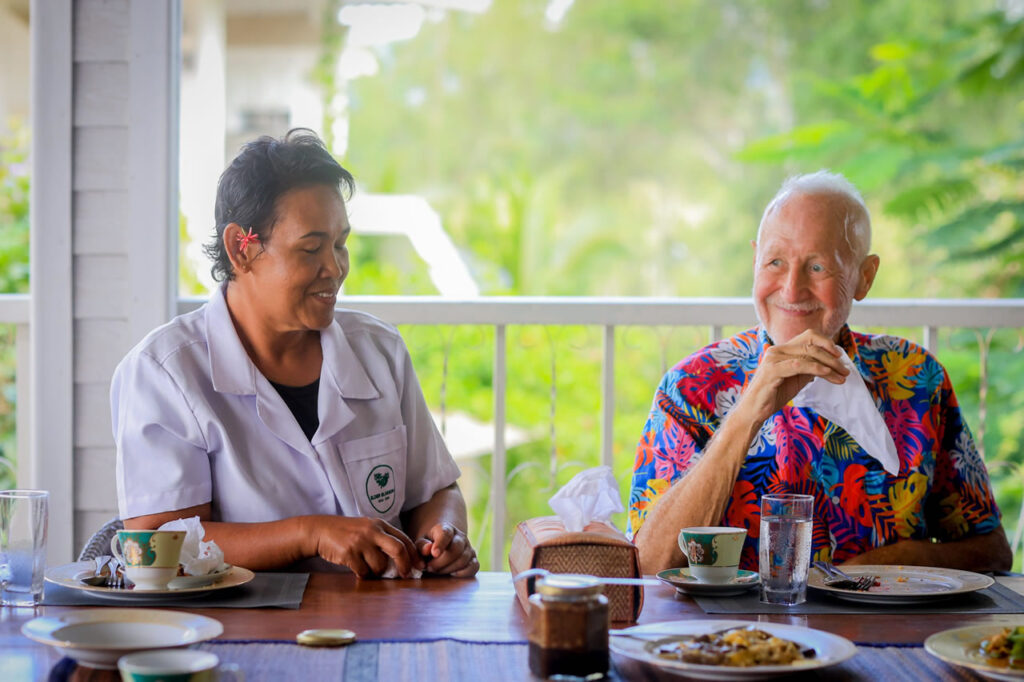
One example is Sunshine International Retirement Residence, which offers retirement living, assisted living, rehabilitation services, and long-term care support. The facility is well known among foreign retirees and is designed to accommodate residents whose care needs may change over time.
Another option is Elder Blossom, a senior-focused community that combines independent living with access to support services. It is aimed at older adults who wish to remain active while having assistance available when needed.
Prosana takes a slightly different approach, focusing on retirement-home living and personal care for older adults who require additional support. The facility was notably the first officially licensed retirement home in Hua Hin and caters to residents seeking a more structured care environment.
📌 The best assisted living option is not necessarily the one offering the most services, but the one that provides the right balance between independence, support, and quality of life.
A Growing Need Among Expats
As Hua Hin’s retirement population continues to grow, demand for assisted living and support services is increasing as well.
Many retirees arrive in excellent health and remain independent for years. However, having suitable support options available later in life provides reassurance for both residents and their families.
✅ For this reason, assisted living is becoming an increasingly important part of Hua Hin’s overall retirement infrastructure.
Nursing Homes & Full-Time Care
While most retirees hope to remain independent for as long as possible, there may come a point when a higher level of support becomes necessary. Serious health conditions, advanced age, mobility limitations, or cognitive decline can make it difficult to live safely without ongoing assistance.
This is where nursing homes and full-time care services come into the picture.
Although these options are not relevant for every retiree, understanding what is available can help individuals and families prepare for the future and make informed decisions before a crisis occurs.
When Full-Time Care May Be Needed
Nursing care is generally intended for people who require substantial assistance with daily living or ongoing medical supervision.
Common situations include:
- Advanced mobility problems
- Dementia or Alzheimer’s disease
- Stroke recovery
- Parkinson’s disease
- Chronic illnesses requiring regular monitoring
- Significant disabilities
- Recovery after major surgery or hospitalization
📌 The level of support required varies considerably from person to person. Some individuals need assistance with only a few daily activities, while others require around-the-clock care.
What Nursing Care Typically Includes
Facilities offering nursing care generally provide a combination of personal assistance and medical support.
Services may include:
- 24-hour supervision
- Medication management
- Assistance with bathing and dressing
- Mobility support
- Meal preparation and feeding assistance
- Health monitoring
- Rehabilitation services
- Coordination with doctors and hospitals
📌 The exact services offered depend on the facility and the needs of the resident.
Nursing Homes vs Private Caregivers
One aspect that often surprises foreigners is that moving into a nursing home is not always the first option in Thailand.
Many families and retirees choose to hire private caregivers instead, particularly when they wish to remain in familiar surroundings.
This approach can allow an individual to continue living at home while receiving support with daily activities and healthcare needs.
📌 In some situations, a caregiver may be sufficient for many years before a dedicated nursing facility becomes necessary.
What Families Should Consider
Choosing a nursing home or arranging full-time care is rarely an easy decision.
Factors that are often important include:
- Quality of care
- Staff experience
- Medical support availability
- Language considerations
- Emergency procedures
- Location
- Cost
- Ability to accommodate changing healthcare needs
📌 The right care solution is often the one that can adapt as circumstances change. A facility that meets today’s needs may not necessarily provide the level of support required several years from now.
Planning Before It Becomes Urgent
One of the challenges with long-term care is that decisions are often made during periods of stress, illness, or hospitalization.
Researching available options before they are needed can make the process significantly easier later on.
📌 Even if full-time care is never required, understanding what support exists in Hua Hin can provide valuable peace of mind for retirees and their families.
Examples of Nursing Care & Rehabilitation Facilities in Hua Hin
Hua Hin offers several facilities that provide higher levels of support for retirees and individuals recovering from illness, surgery, or age-related conditions.
One example is We Nursing Home, which specializes in nursing care, rehabilitation, and post-hospital recovery. Services include support for residents with mobility limitations, chronic medical conditions, dementia, Parkinson’s disease, and other healthcare needs that require ongoing supervision and assistance.
Another provider is Nucharat Healthcare Group, which operates a range of elder-care and healthcare services in Hua Hin, including residential care through Sunny Home. The organization focuses on long-term care, rehabilitation, and support for older adults requiring varying levels of assistance.
📌 Nursing care facilities can differ significantly in terms of medical support, rehabilitation services, staffing levels, and accommodation. Taking the time to understand what care is available both now and in the future can help families make more informed long-term decisions.
A Practical Reality of Long-Term Retirement
Healthcare planning is often viewed through the lens of hospitals and insurance policies. However, for some retirees, the more important question eventually becomes how daily support will be managed if health or mobility declines.
The good news is that Hua Hin offers a range of care options, from home caregivers and assisted living arrangements to full-time nursing support. This gives retirees flexibility as their needs evolve over time and helps make long-term retirement in Hua Hin a realistic option for many people.
Home Care Services in Hua Hin
For many retirees, the ideal solution is not moving into an assisted living facility or nursing home at all. Instead, they prefer to remain in their own home for as long as possible while receiving support as needed.
This approach, often referred to as aging in place, has become increasingly popular in Thailand and is one of the reasons many retirees are able to maintain their independence well into later life.
In Hua Hin, a range of home care services are available that can provide assistance without requiring a major change in living arrangements.
Aging in Place
Most people feel comfortable in familiar surroundings.
Remaining in your own home allows you to:
- Maintain established routines
- Stay connected to friends and neighbors
- Keep personal belongings and familiar surroundings
- Retain a greater sense of independence
- Avoid the disruption of relocating to a care facility
📌 For many retirees, this option provides the best balance between support and quality of life.
Types of Home Care Available
The level of assistance can vary significantly depending on individual needs.
Visiting Nurses
Qualified nurses may visit periodically to provide medical support such as:
- Wound care
- Blood pressure monitoring
- Medication administration
- Health assessments
- Post-surgical follow-up
Part-Time Caregivers
Some retirees only require assistance for a few hours each day.
Part-time caregivers may help with:
- Household tasks
- Meal preparation
- Shopping
- Transportation
- Companionship
Full-Time or Live-In Caregivers
For individuals requiring more regular support, full-time or live-in caregivers may be an option.
Responsibilities can include:
- Personal care assistance
- Mobility support
- Medication reminders
- Meal preparation
- General supervision
📌 This arrangement often allows retirees to remain at home even when their care needs increase.
Rehabilitation & Recovery Support
Home-based support can also be useful following:
- Surgery
- Hospitalization
- Injury
- Illness
📌 Physiotherapists and rehabilitation specialists may provide treatment in the home, helping individuals regain strength and mobility during recovery.
Advantages of Home Care
One of the biggest benefits of home care is flexibility.
Support can often be adjusted as needs change, allowing retirees to receive exactly the level of assistance required.
Other advantages include:
- Familiar surroundings
- Greater independence
- Personalized care
- Potentially lower costs than residential care
- Ability to remain close to family and friends
📌 For many people, home care feels less institutional and more personal than moving into a dedicated facility.
Potential Challenges
Home care is not the perfect solution for everyone.
Some situations may eventually require more comprehensive support than can realistically be provided at home.
Potential challenges include:
- Managing complex medical conditions
- Limited social interaction
- Coordinating multiple caregivers or providers
- Home modifications for mobility issues
- Increasing costs as care requirements grow
📌 These factors should be considered when developing a long-term retirement plan.
Examples of Home Care Services in Hua Hin
For retirees who wish to remain in their own homes, Hua Hin offers a variety of professional home care and nursing services.
One example is Quality Home Care & Caregivers, which provides in-home support ranging from companionship and personal care to assistance with daily activities. Services such as these can help retirees maintain their independence while receiving support tailored to their individual needs.
Another provider is ANNY Healthcare, which offers a broad range of home-based healthcare services, including nursing care, caregiver support, rehabilitation assistance, post-operative recovery care, dementia support, and end-of-life care. The organization also provides services for individuals recovering from surgery, stroke, or other medical conditions that require ongoing assistance at home.
📌 One of the advantages of home care is flexibility. Support can often be adjusted over time, allowing retirees to receive additional assistance as their needs evolve without necessarily having to leave their own home.
An Important Part of the Care Continuum
Home care plays an important role in Hua Hin’s healthcare and retirement landscape.
Many retirees move gradually from complete independence to occasional assistance, then to more regular support as circumstances change. Home care often provides the bridge between these stages, helping people remain in their own homes for longer while still receiving the assistance they need.
📌 For many retirees, home care provides a practical middle ground between complete independence and residential care, offering support when needed while allowing them to remain in familiar surroundings.
Looking beyond Hua Hin?
This guide focuses on healthcare and care options available in Hua Hin. For a broader overview of retirement villages, assisted living facilities, nursing homes, and long-term care services throughout Thailand, see:
Long-Term Care in Thailand: A Guide for Foreign Retirees
Planning Ahead: When to Start Thinking About Assisted Living
Most retirees move to Hua Hin with the intention of enjoying an active and independent lifestyle for many years. In many cases, that is exactly what happens. However, one of the advantages of planning ahead is understanding what support options are available if circumstances change in the future.
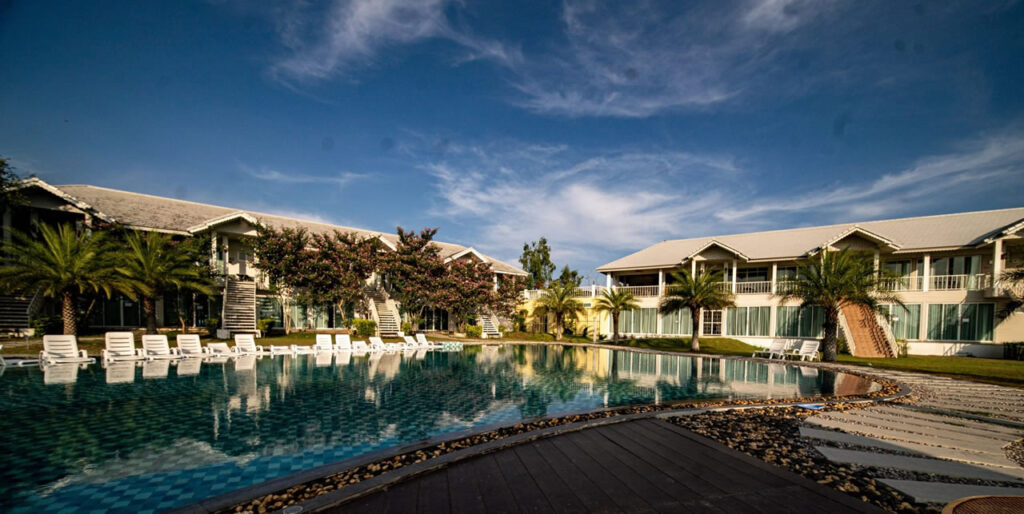
Planning for assisted living, home care, or nursing support does not mean expecting the worst. Rather, it means being prepared and informed before important decisions need to be made.
Why Early Planning Matters
One of the biggest challenges families face is that long-term care decisions are often made during periods of stress.
A fall, a stroke, an unexpected hospitalization, or the gradual onset of cognitive decline can force difficult decisions that may need to be made quickly.
By researching available options in advance, retirees and their families can evaluate facilities, understand costs, and consider future preferences without feeling pressured by immediate circumstances.
📌 The best time to learn about long-term care options is usually before they become necessary.
Signs It May Be Time to Explore Additional Support
There is no specific age at which someone should consider assisted living or home care. Instead, the need for support is usually driven by changes in health, mobility, or daily routines.
Some common signs include:
- Increasing difficulty managing household tasks
- Frequent falls or mobility concerns
- Difficulty driving or attending appointments independently
- Managing multiple medications
- Memory-related concerns
- Social isolation or loneliness
- A spouse or family caregiver becoming overwhelmed
Experiencing one or more of these challenges does not automatically mean a move into assisted living is required. In many cases, simple adjustments or home-care services may provide sufficient support.
📌 Needing assistance is not necessarily a loss of independence. Often, the right support helps people remain independent for longer.
Questions Worth Asking Yourself
Even healthy retirees can benefit from thinking about future possibilities.
Questions worth considering include:
- Would my current home still be practical if my mobility declined?
- How would I access healthcare if I could no longer drive?
- Do I have family nearby who could assist if needed?
- Would I prefer home care or a retirement community?
- How would long-term care costs fit into my retirement budget?
- What level of support would I be comfortable receiving?
📌 There are no right or wrong answers, but considering these questions early can make future decisions easier.
Involving Family in the Conversation
For many retirees, long-term care decisions affect more than just the individual.
Spouses, adult children, and other family members are often involved in planning and support. Discussing preferences before care becomes necessary can help avoid misunderstandings and reduce stress later on.
This can be particularly important for retirees whose family members live overseas and may not be familiar with the care options available in Thailand.
Having a Plan Doesn’t Mean You’ll Need It
Many retirees living in Hua Hin remain active and independent throughout their retirement years and never require assisted living or nursing care.
However, understanding the available options can provide valuable peace of mind. Knowing what support exists, where it is available, and how it fits into your long-term plans allows future decisions to be made from a position of knowledge rather than urgency.
📌 The goal is not to plan for the worst. It is simply to ensure that if circumstances change, you and your family already understand the options available.
What Does Healthcare and Elder Care Cost in Hua Hin?
One reason many retirees choose Thailand is that healthcare and long-term care are often more affordable than in many Western countries. However, costs can still vary considerably depending on the level of support required, the type of accommodation chosen, and whether care is provided at home or in a dedicated facility.
While some retirees may only require occasional medical appointments and routine healthcare, others may eventually need regular home care, assisted living, or full-time nursing support.
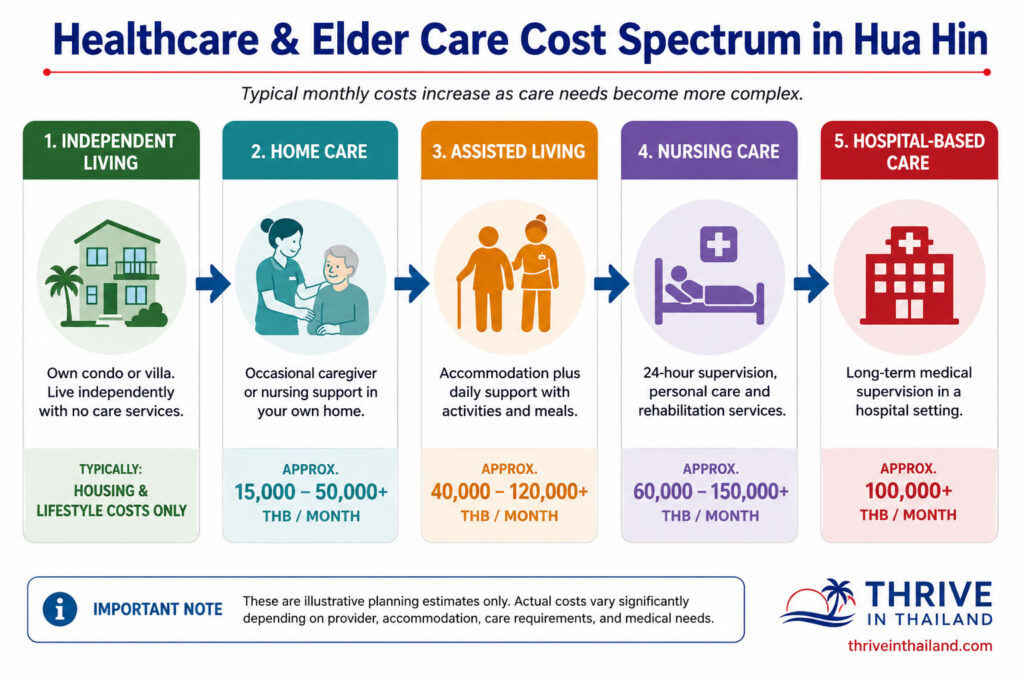
The infographic above illustrates how costs generally increase as care needs become more complex. Actual costs can vary considerably depending on accommodation standards, medical requirements, staffing ratios, and the provider selected. Contact individual providers directly for current pricing and availability.
Typical Healthcare Costs
Routine healthcare expenses in Hua Hin are generally manageable for most retirees.
Examples may include:
- General practitioner consultations
- Specialist appointments
- Diagnostic testing
- Prescription medications
- Physiotherapy
- Dental care
While costs vary depending on the provider and treatment involved, many retirees can expect to pay approximately:
- General practitioner consultation: 800–2,000 THB
- Specialist consultation: 1,500–4,000+ THB
- Physiotherapy session: 800–2,500 THB
- Dental cleaning: 1,000–3,000 THB
- Comprehensive health screening package: 5,000–30,000+ THB
The exact costs will depend on the provider, complexity of treatment, and whether services are obtained through a hospital or an independent clinic. Even so, many retirees find private healthcare in Thailand significantly less expensive than comparable services in North America, Australia, or parts of Europe.
📌 Comprehensive health insurance can help reduce exposure to larger medical expenses, particularly those involving hospitalization or surgery.
Home Care Costs
Home care is often one of the most flexible care options available.
Costs vary depending on:
- Number of hours required
- Qualifications of the caregiver
- Nursing requirements
- Overnight care needs
- Specialized medical support
Typical costs may include:
- Occasional caregiver visits: 500–1,500 THB per visit
- Part-time caregiver support: 10,000–30,000+ THB per month
- Full-time or live-in caregiver: 15,000–50,000+ THB per month
Part-time assistance is generally more affordable than residential care, while full-time or live-in caregivers naturally involve higher ongoing costs.
📌 Nursing qualifications, overnight support, and specialized medical requirements can increase costs significantly. Many retirees begin with occasional support and gradually increase services as their needs evolve.
Assisted Living Costs
Assisted living facilities typically combine accommodation with varying levels of support and care.
Monthly costs may be influenced by:
- Accommodation type
- Level of assistance required
- Meal plans
- Medical supervision
- Additional services and activities
In Hua Hin, assisted living arrangements typically range from 40,000–120,000+ THB per month, depending on the level of support provided and the type of accommodation selected.
Facilities focused primarily on independent retirement living are often found at the lower end of the range, while those offering more comprehensive personal care, nursing support, and healthcare services generally command higher fees.
📌 Facilities offering extensive healthcare support and individualized care plans typically cost more than communities designed mainly for active retirees seeking convenience, security, and social opportunities.
Nursing Care & Rehabilitation Costs
Nursing care is usually the most expensive long-term care option because of the higher staffing levels and medical support involved.
Costs may vary based on:
- Care complexity
- Medical supervision requirements
- Rehabilitation services
- Specialized dementia care
- Private versus shared accommodation
In Hua Hin, nursing care and rehabilitation services typically range from 60,000–150,000+ THB per month, with some specialized or hospital-based arrangements exceeding these levels.
Individuals requiring intensive nursing support, dementia care, ongoing rehabilitation, or 24-hour medical supervision should expect significantly higher costs than those receiving basic assistance with daily living.
📌 The level of care required is often the single biggest factor influencing long-term care expenses. Dementia care, intensive rehabilitation programs, and round-the-clock nursing support are generally among the most expensive long-term care options available.
Factors That Influence Cost
Several factors can affect the overall cost of healthcare and elder care in Hua Hin:
- Age and health condition
- Type of accommodation
- Level of personal assistance required
- Frequency of medical care
- Insurance coverage
- Choice of provider
- Duration of care
📌 As a result, two retirees living in Hua Hin may have vastly different healthcare budgets despite living in the same town.
Value Beyond Cost
While affordability is important, cost should rarely be the only consideration when evaluating healthcare or elder care options.
Quality of care, staff experience, access to medical services, location, and overall quality of life are often just as important as the monthly price.
For many retirees, the goal is not simply to find the cheapest option, but to find a solution that provides the right balance of care, comfort, and long-term peace of mind.
📌 In many cases, the most affordable option today may not necessarily be the most suitable option several years from now.
Pros and Cons of Growing Older in Hua Hin
Like any retirement destination, Hua Hin has both advantages and limitations. While the town offers excellent healthcare, a relaxed lifestyle, and a growing range of retirement-care services, it may not be the perfect fit for everyone.
Understanding both sides of the equation can help retirees make a more informed decision about whether Hua Hin aligns with their long-term needs and expectations.
✅ Advantages
Strong Healthcare Infrastructure
One of Hua Hin’s greatest strengths is the quality of its healthcare system.
Residents have access to:
- Modern private hospitals
- Specialist medical services
- Physiotherapy and rehabilitation
- Home care providers
- Assisted living facilities
- Nursing care options
📌 For a town of its size, Hua Hin offers a surprisingly comprehensive range of healthcare and retirement-care services.
Established Expat Community
Hua Hin has long been one of Thailand’s most popular retirement destinations.
This means retirees can benefit from:
- Active social groups
- Expat clubs and organizations
- English-speaking service providers
- Established support networks
📌 For many newcomers, these communities help ease the transition into retirement abroad.
Relaxed Lifestyle
Compared with Bangkok or some of Thailand’s larger cities, Hua Hin offers a slower pace of life.
Many retirees appreciate:
- Less traffic
- Walkable areas
- Beachfront surroundings
- Easy access to shops and services
- A generally relaxed atmosphere
Access to Bangkok
Although Hua Hin feels far removed from the capital, Bangkok remains relatively accessible.
This provides access to:
- Additional specialist hospitals
- International airports
- Government services
- Family travel connections
📌 For retirees, having a major city within reach can be reassuring.
❌ Potential Drawbacks
Limited Public Transportation
While getting around Hua Hin is relatively easy, public transportation options remain limited compared with larger cities.
As mobility declines, some retirees may become increasingly dependent on:
- Family members
- Private drivers
- Ride-hailing services
- Caregivers
Fewer Healthcare Options Than Bangkok
Although healthcare in Hua Hin is excellent, Bangkok still offers a larger selection of:
- Hospitals
- Medical specialists
- Specialized treatment centers
📌 For highly complex medical conditions, some residents may occasionally need to travel to the capital.
Long-Term Care Planning Is Still Important
While Hua Hin offers more retirement-care options than many parts of Thailand, the sector is still developing.
Not every facility provides the same level of support, and availability may change over time as demand increases.
For this reason, planning ahead remains important.
Distance from Family
For many foreign retirees, one of the biggest challenges has little to do with healthcare at all.
Family members often live thousands of kilometers away.
As people age, being separated from adult children, grandchildren, or close relatives can become increasingly significant.
The Overall Picture
For most retirees, the advantages of Hua Hin significantly outweigh the disadvantages.
The combination of quality healthcare, a large retirement community, a relaxed coastal lifestyle, and an expanding range of elder-care services makes Hua Hin one of Thailand’s strongest destinations for long-term retirement.
📌 No retirement destination is perfect, but Hua Hin offers something many retirees value highly: the ability to remain independent today while having access to increasing levels of support if those needs change in the future.
Is Hua Hin a Good Place to Retire Long-Term?
Throughout this guide, we’ve explored Hua Hin’s healthcare system, retirement communities, assisted living options, nursing care facilities, and home-care services. The overall picture is clear: Hua Hin offers one of the most developed retirement-care ecosystems outside of Bangkok.

For active retirees, the town provides access to quality healthcare, a relaxed lifestyle, and a well-established expat community. For those who eventually require additional support, there are growing options ranging from home caregivers and rehabilitation services to assisted living facilities and full-time nursing care.
Perhaps most importantly, Hua Hin allows many retirees to age in place. Rather than being forced to relocate when health circumstances change, it is often possible to move gradually along the care continuum, from independent living to home care, assisted living, or nursing support as needed.
That flexibility is one of Hua Hin’s greatest strengths.
Of course, no retirement destination can guarantee perfect healthcare or eliminate every challenge associated with aging. Long-term planning, adequate financial resources, and realistic expectations remain important wherever you choose to live.
However, for retirees seeking a location that combines quality medical care, a comfortable lifestyle, and increasing levels of support as they grow older, Hua Hin remains one of the strongest retirement destinations in Thailand.
✅ Still deciding whether Hua Hin is the right place to retire?
Healthcare is one of the most important considerations, but it’s only part of the picture. Read my complete Retire in Hua Hin guide to explore the cost of living, visas, neighbourhoods, safety, and everyday lifestyle before making your decision.
One thing that stood out while researching this article is that having elder-care options available and being able to afford them are two very different things.
Hua Hin offers a surprisingly wide range of services, from home caregivers and assisted living facilities to rehabilitation centers and nursing care. However, many of these services are expensive by Thai standards and may place a significant strain on a retiree’s budget if long-term care becomes necessary.
Another reality worth mentioning is that many foreign retirees in Thailand rely heavily on the support of a Thai spouse or partner as they grow older. In some cases, this allows people to remain at home far longer than would be practical in Western countries, where professional care services are often the only option.
For me, the main takeaway is that healthcare planning should extend beyond hospitals and insurance. It’s equally important to think about who would help you if your mobility declined, how care would be funded, and what support system you would have in place later in life.

Hua Hin Hub
Explore my collection of Hua Hin guides covering living, healthcare, costs, accommodation, retirement, and everyday life on Thailand’s Gulf Coast.
Essential Guides for Living in Thailand
Whether you’re planning a move, considering retirement, or simply exploring long-term life in Thailand, these guides will help you understand the bigger picture and make more informed decisions.
| Essential Guide | Why It’s Worth Reading |
|---|---|
| Thailand Health Insurance Guide | Understand your options for medical coverage and what’s required for long-term stays. |
| Long-Term Visa Options for Thailand | Explore the visa types available for retirees and long-term expats. |
| Best Places to Live in Thailand | Compare Hua Hin with other popular destinations to find your ideal base. |
| Banking & Financial Tips for Expats in Thailand | Learn how to manage money, transfer funds, and avoid common financial mistakes. |
| How to Embrace Thai Culture | Adjust more easily to daily life by understanding local customs and expectations. |
Frequently Asked Questions
📌 Can foreigners use Thai government hospitals in Hua Hin?
Yes. Foreigners can generally access treatment at government hospitals in Hua Hin, although fees are typically higher than those charged to Thai citizens under public healthcare schemes. Government hospitals are often significantly less expensive than private hospitals, but waiting times may be longer and English-language support may be more limited.
Many retirees use a combination of private and public healthcare depending on their medical needs, budget, and insurance coverage.
📌 Will health insurance cover assisted living or nursing care in Thailand?
Not necessarily.
Most health insurance policies are designed to cover medical treatment such as hospitalization, surgery, specialist consultations, and diagnostic testing. Long-term care services such as assisted living, nursing homes, caregivers, and personal care support are often excluded or only covered under specific circumstances.
Because policy terms vary considerably, it is important to review coverage carefully and understand what is and is not included before relying on insurance to fund future care needs.
📌 Is it possible to hire a live-in caregiver in Hua Hin?
Yes. Many retirees in Hua Hin choose to hire a live-in caregiver rather than move into an assisted living facility or nursing home.
Depending on the individual’s needs, caregivers may assist with personal care, meal preparation, medication reminders, mobility support, transportation, and companionship.
For some retirees, a live-in caregiver can provide enough assistance to remain at home for many years while maintaining a familiar and comfortable environment.
📌 What happens if I need specialist treatment that isn’t available in Hua Hin?
While Hua Hin offers excellent healthcare for a town of its size, Bangkok remains Thailand’s primary center for highly specialized medical treatment.
If advanced procedures, rare specialists, or complex treatments are required, patients may occasionally be referred to hospitals in Bangkok. Fortunately, the capital is only a few hours away by road, making access to additional medical services relatively straightforward when necessary.
For most routine healthcare needs, however, retirees find that Hua Hin’s hospitals and clinics provide more than adequate care.
📌 Can I move into assisted living in Hua Hin without speaking Thai?
Yes.
Many assisted living facilities, retirement communities, and healthcare providers in Hua Hin regularly work with international residents. English-speaking staff are common in facilities that cater to foreign retirees, although language capabilities can vary between providers.
Even so, learning some basic Thai can be helpful when interacting with caregivers, support staff, and local healthcare services.
While speaking Thai is certainly beneficial, it is generally not a requirement for foreign retirees considering assisted living or long-term care in Hua Hin.
💬 Do you have experience with healthcare or assisted living in Hua Hin? Feel free to share your thoughts or insights in the comments below.