


Thai food ranges from a quick plate of fried rice to a shared meal of curries, soups, vegetables and grilled fish. Some dishes are fiery, others mild, and ingredients such as lemongrass, galangal, lime and fresh herbs contribute far more than heat.
There is plenty of variety beyond the familiar restaurant favourites. Regional cooking, different versions of the same dish and individual cooks’ preferences all give you something new to try.
This guide introduces ten popular Thai dishes, explaining what they are, how they taste and what to know when ordering. It also looks at regional differences and offers practical guidance on chilli levels, shared meals and ingredients that may be less obvious from an English menu.
Popular Thai Dishes at a Glance
These ten dishes offer a useful starting point. Heat levels vary between cooks and versions, so treat the descriptions below as a guide rather than a guarantee.
| Dish | What It Is | Flavour and Heat |
|---|---|---|
| Pad Thai | Stir-fried rice noodles, commonly with egg, tofu and prawns | Sweet, sour and savoury; usually mild, with dried chilli served separately |
| Pad Kra Pao | Meat or seafood stir-fried with holy basil, garlic and chilli, usually served with rice | Savoury and aromatic; often hot |
| Khao Pad | Thai fried rice, commonly with egg and a choice of meat or seafood | Savoury and usually mild; chilli condiments add heat |
| Tom Yum Goong | Hot and sour prawn soup with lemongrass, galangal and makrut lime leaves | Sharp, aromatic and commonly spicy; clear and creamy versions are available |
| Tom Kha Gai | Chicken soup with coconut milk, galangal and other herbs | Creamy, tangy and aromatic; often gentler than tom yum, but may contain chilli |
| Green Curry | Coconut milk curry made with green chilli paste, commonly with meat and Thai aubergines | Rich and herbal; can be very spicy despite its creamy appearance |
| Massaman Curry | Coconut milk curry, commonly with chicken or beef, potatoes, onions and peanuts | Rich, gently sweet and fragrant with dried spices; usually relatively mild |
| Som Tam | Green papaya salad pounded with chilli, lime and seasonings that vary by style | Crunchy, sour and salty, sometimes sweet; can be very hot |
| Khao Soi | Northern-style coconut curry noodle soup, commonly with chicken or beef and crispy noodles | Rich and aromatic; heat varies, with chilli oil or paste often served alongside |
| Mango Sticky Rice | Ripe mango with sweetened coconut sticky rice and coconut sauce | Sweet and creamy with a lightly salty coconut topping; no chilli heat |
Thai Dishes to Try
Pad Thai — Stir-Fried Rice Noodles
Pad Thai combines rice noodles with egg, firm tofu, bean sprouts and Chinese chives. Tamarind gives the sauce its sourness, balanced by sugar and savoury seasonings such as fish sauce. Crushed peanuts and a wedge of lime commonly accompany the finished dish.

Prawns are a familiar addition, while some restaurants also offer chicken or vegetarian versions. Tofu is often part of the standard recipe, so its presence does not mean the dish is vegetarian: fish sauce and dried shrimp may still be included.
Usually relatively mild, Pad Thai is an accessible starting point if you are unfamiliar with Thai food. Some cooks add chilli during preparation, while dried chilli is often available separately. It is generally served as a complete noodle meal rather than with rice.
Pad Kra Pao — Holy Basil Stir-Fry
Pad Kra Pao is an everyday favourite made by stir-frying meat or seafood with garlic, chilli and holy basil. The basil gives it a distinctive peppery aroma and differs from the sweeter Thai basil used in many curries. Minced pork and chicken are common choices, although beef, crispy pork and seafood versions are also widely available.
It is usually served over rice, often with a fried egg (khai dao) added to the order. The crisp edges and soft yolk complement the strongly flavoured stir-fry.
This can be a hot dish, so ask for less chilli if that suits your taste. Since it is generally cooked to order, adjusting the amount is often possible. Even with less heat, the garlic and holy basil give it plenty of character.
Khao Pad — Thai Fried Rice
Khao Pad is rice stir-fried with egg, savoury seasonings and ingredients such as pork, chicken, prawns or crab. Vegetables vary between cooks, with onion, spring onion and tomato among the common additions. It usually arrives with cucumber slices and a wedge of lime.
Unlike many chilli-based dishes, standard Thai fried rice is usually mild. A squeeze of lime adds freshness, while prik nam pla—fish sauce with sliced chillies—allows you to add saltiness and heat at the table.
It works well as a quick meal on its own. For something different from the usual chicken or pork version, look for khao pad pu, made with crab meat. As with other rice dishes, ordering it with vegetables does not automatically make it vegetarian, since the seasonings may include fish sauce or other animal-based sauces.
Tom Yum Goong — Hot and Sour Prawn Soup
Tom Yum Goong is a hot and sour prawn soup scented with lemongrass, galangal and makrut lime leaves. Lime juice provides its sharpness, while chilli and fish sauce contribute heat and savoury depth. Mushrooms are a common addition.

Two versions are worth recognising: nam sai has a clear broth, while nam khon is richer, commonly made with roasted chilli paste and evaporated milk. A creamy appearance does not necessarily mean it contains coconut milk or that it will be mild.
It is often ordered as part of a shared meal, with steamed rice served separately. The pieces of lemongrass, galangal and lime leaf flavour the broth but are generally left uneaten because they are tough. If you enjoy the soup but prefer another protein, look for versions made with fish, chicken or mixed seafood.
Tom Kha Gai — Chicken and Coconut Soup
Tom Kha Gai combines chicken and coconut milk with galangal, lemongrass and makrut lime leaves. Galangal is central to the dish: kha is the Thai name for this aromatic rhizome, which is related to ginger but has a different flavour. Mushrooms are a common addition, with lime juice and fish sauce giving the soup a tangy, savoury balance.
It is often gentler than Tom Yum, although fresh chillies can still give it noticeable heat. The coconut milk adds richness without turning it into a sweet soup.
Usually eaten with steamed rice as part of a meal, Tom Kha Gai is a useful choice when sharing several strongly flavoured dishes. As with Tom Yum, the tough pieces of herbs and galangal are generally left in the bowl.
Green Curry — Gaeng Khiao Wan
Green curry is made with a paste of green chillies, herbs and spices, simmered with coconut milk. Chicken is a common choice, alongside Thai aubergines and Thai basil, although versions with beef, fish balls or other ingredients are also available.
Despite its pale green colour and creamy appearance, it can be one of the hotter dishes on the table. The word wan means sweet, but the finished curry is a savoury dish with some sweetness balancing the chilli and aromatic herbs.
It is commonly served with steamed rice or khanom chin, soft rice noodles that absorb the sauce. Much of the heat comes from the curry paste itself, so a kitchen may have less scope to make it mild than a stir-fry cooked with fresh chillies. Vegetarian versions need a suitable paste as well as a change of protein, since many curry pastes contain shrimp paste.
Massaman Curry
Massaman is a rich coconut milk curry with roots in Muslim cooking. Spices such as cinnamon, cardamom and cloves give it a different character from the fresh chilli and herb flavours of green curry. Chicken and beef are common choices, usually cooked with potatoes, onions and peanuts.
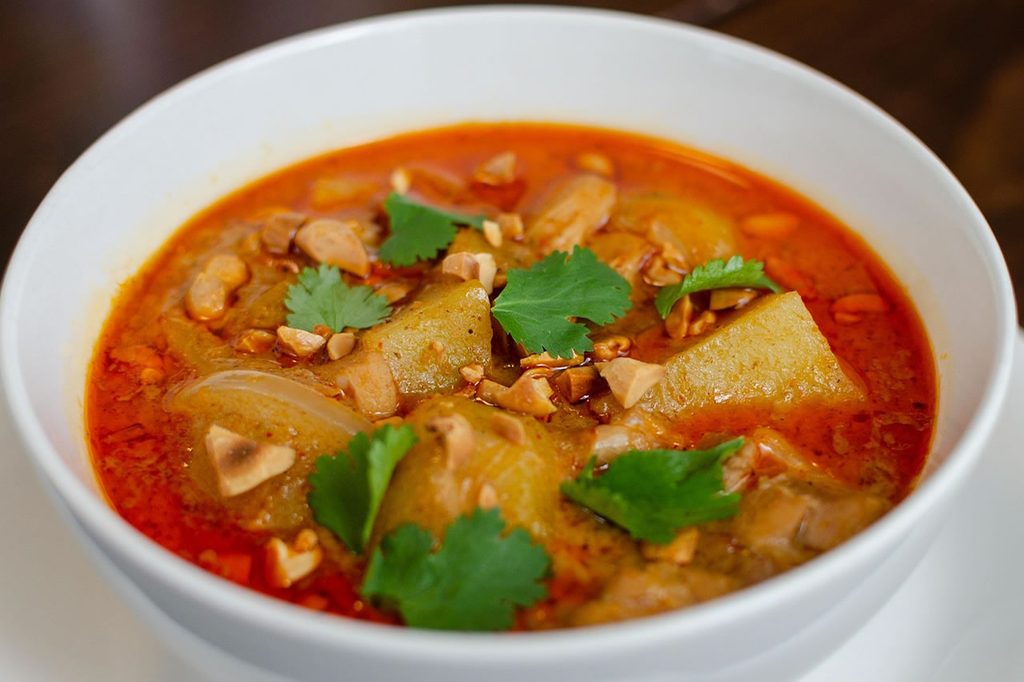
The sauce combines sweetness with savoury depth and a little sourness, often from tamarind. It is generally relatively mild by Thai curry standards, although the amount of chilli varies between cooks.
Served with steamed rice or sometimes roti, Massaman makes a substantial meal. The meat is typically simmered until tender, so it is often prepared in advance rather than cooked from scratch for each order. This also means there may be limited scope to adjust its ingredients or heat.
Som Tam — Green Papaya Salad
Som Tam is made with shredded unripe papaya, pounded in a mortar with ingredients such as garlic, chilli, lime, tomatoes and long beans. The papaya is firm and crunchy, rather than soft and sweet like the ripe fruit. The dressing varies by style, giving different balances of sourness, saltiness, sweetness and heat.

Two common versions are worth knowing:
- Tam Thai: commonly made with peanuts, dried shrimp, fish sauce, lime and palm sugar, without pla ra.
- Tam Pla Ra: made with fermented fish seasoning, giving it a stronger aroma and a deeper savoury flavour. Some versions also include salted or pickled crab.
I prefer Tam Thai for its slightly sweet flavour and because it comes without pla ra. Both styles have their own appeal, and neither is necessarily mild.
Som Tam is often eaten with sticky rice and grilled chicken. Since the salad is usually prepared to order, you can ask for fewer chillies or less sugar. If you want to avoid pla ra or crab, specify that when ordering, as a stall may offer several combinations.
Khao Soi — Northern Curry Noodles
Khao Soi is closely associated with northern Thailand, particularly Chiang Mai and Chiang Rai. The familiar northern version combines soft egg noodles with a coconut curry broth, topped with a nest of crispy fried noodles. Chicken, often served on the bone, and beef are common choices.
The broth is rich and aromatic, with dried spices contributing to its character. Pickled mustard greens, shallots and lime are usually served alongside, adding sourness, crunch and freshness. Roasted chilli paste or chilli oil lets you increase the heat, although the broth itself may already be spicy.
Khao Soi is my favourite northern Thai dish. It is a complete noodle meal, usually eaten with a spoon and chopsticks. If you are travelling in the North, it is a useful dish to seek out at a specialist noodle shop, where the menu may focus on just a few versions.
Mango Sticky Rice — Khao Niao Mamuang
Mango sticky rice pairs ripe, sweet mango with glutinous rice enriched with sweetened coconut milk. A lightly salted coconut sauce is spooned over the rice, sometimes finished with crispy mung beans or sesame seeds. Despite its name, glutinous rice does not contain gluten; the term describes its sticky texture.

The contrast between fresh mango, rich coconut and slightly salty sauce makes this my favourite Thai dessert. The rice should be tender and sticky, with enough coconut flavour to complement the fruit.
You can find it at dessert stalls, markets and restaurants. Availability extends beyond the main mango season, but the variety and ripeness of the fruit make a noticeable difference. It is filling, so a portion shared after a meal may be enough.
Regional Differences
Many Thai dishes are available throughout the country, but regional cooking offers much more variety than a typical restaurant menu suggests. The North, Northeast, Central region and South provide a useful introduction, although each contains its own local traditions.
Northern Thailand
Northern cooking includes herb-rich dishes, chilli dips, grilled meats and curries, many made without coconut milk. Sticky rice is a staple, eaten alongside dishes such as sai oua, an aromatic pork sausage, and nam prik num, a roasted green chilli dip often served with vegetables and crispy pork rind.
Khao Soi is the best-known northern dish among many visitors, but it represents only one part of the region’s food.
Northeastern Thailand — Isaan
Isaan food is known for grilled meats, sharp salads, fresh herbs and fermented seasonings such as pla ra. Som Tam, grilled chicken and sticky rice make a familiar combination.
Another dish to try is larb, a minced meat salad commonly seasoned with lime, chilli, herbs and toasted rice powder. Sai krok Isaan, a fermented pork-and-rice sausage, offers a distinctly sour flavour.
Central Thailand
Central cooking includes many dishes familiar from Thai restaurants overseas, including green curry and Tom Yum. Steamed jasmine rice commonly accompanies shared dishes, with coconut-based curries, clear soups, stir-fries and chilli dips all forming part of the region’s cooking.
Bangkok also brings together food from across Thailand, making it a convenient place to explore several regional styles.
Southern Thailand
Southern cooking often features pronounced chilli heat, sour flavours, turmeric, seafood and fermented fish or shrimp seasonings. Coconut milk is important in some dishes, but plenty of southern food is made without it.
Look for khua kling, a dry curry commonly made with minced meat, or turmeric-fried fish. For something less fiery, khao yam is a rice salad with finely sliced herbs, vegetables and a distinctive savoury dressing.
📌 These regional associations are a starting point. You will find Isaan restaurants in Hua Hin, northern noodle shops in Bangkok and southern curry stalls far beyond the South.
Ordering Thai Food
Asking for Less Chilli
Phet noi means “a little spicy”, while mai phet means “not spicy”. These are useful requests, although what counts as a little chilli varies between cooks and diners. If you want no chilli added, mai sai phrik expresses that more specifically.
Made-to-order stir-fries and salads usually offer more flexibility than prepared curries or soups. A cook can reduce the fresh chillies in Som Tam, for example, but cannot remove the chilli already blended into a curry paste.
Individual Meals or Shared Dishes
A plate of fried rice, Pad Thai or a bowl of Khao Soi is normally a complete meal for one person. Curries, soups, vegetables and grilled dishes are often ordered to share, with each diner having their own rice.
For a shared meal, variety works well: a curry, a vegetable dish and grilled fish, for example, provide different textures and flavours. There is no need for every dish to be spicy. Rice is not always included in the menu price, so order it separately where necessary.
At a rice-and-curry stall, you can usually choose prepared dishes to be spooned over an individual plate of rice. This is a convenient way to try something you recognise by appearance but do not yet know by name.
Vegetarian Requests and Less Obvious Ingredients
English menu descriptions often name the main ingredient without listing the seasonings. A vegetable stir-fry may contain oyster sauce, a soup may use meat stock, and a curry paste may include shrimp paste. Simply replacing meat with tofu does not necessarily make a dish vegetarian.
Explain which ingredients you avoid rather than relying only on “no meat”. For vegan meals, clarify eggs and dairy as well. If you have a food allergy, make that clear separately from a dietary preference; a written Thai translation can help communicate the specific ingredient.
💬 Which Thai dish do you order most often? Share your favourite in the comments, or tell me about a dish you would like to know more about.