
Udon Thani is one of those Thai cities that doesn’t shout for attention. It just quietly works. It’s modern enough to be comfortable, local enough to feel real, and relaxed enough that you can actually breathe a little. If you’re looking for a place in Thailand that feels less “tourist machine” and more “this could be my routine”, Udon often surprises people in the best way.
This guide is especially useful for slow travelers, long-stay visitors, retirees, and expats who want a practical base in the Northeast. You’ll find plenty of good food, parks, night markets, and day-to-day convenience, plus easy access to the Laos border region. It’s not a bucket-list city, and that’s exactly the point.
Udon Thani sits in Upper Isan (Northeast Thailand) and acts as a regional hub, with solid transport links to Bangkok and nearby provinces. Whether you’re stopping through for a few days or considering a longer stay, this article will help you plan it properly, without fluff and without guesswork.
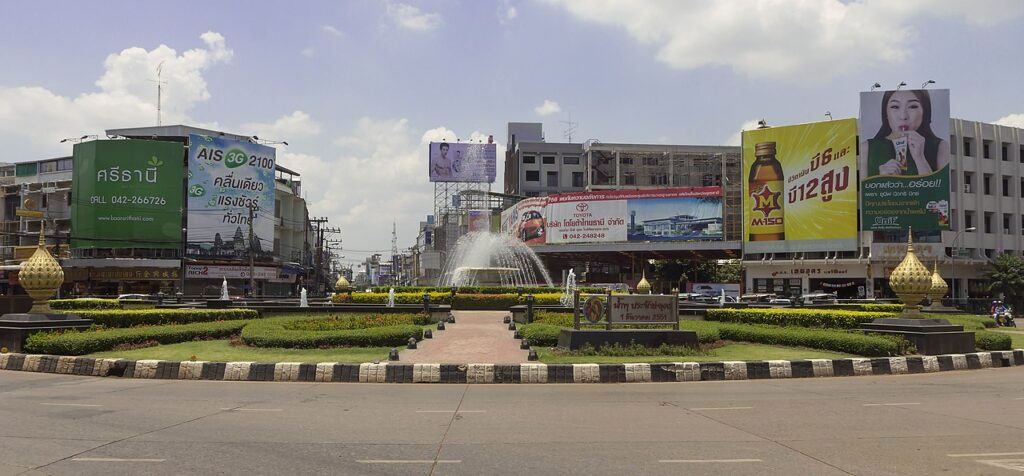
Photo “Udon Thani – Fountain Roundabaout” by Ilya Stefan Fussan on Wikimedia Commons, licensed under CC BY-SA 3.0
Where Is Udon Thani?
Udon Thani is located in Upper Isan (Northeast Thailand), around 560 km northeast of Bangkok. It’s one of the region’s main urban centers and functions as a practical hub rather than a sightseeing stop.
The city sits close to the Laos border, with Nong Khai and the Thai–Lao Friendship Bridge just over an hour away. This makes Udon Thani a convenient base for cross-border travel, regional exploration, and long-stay living in Isan.
Unlike resort towns or historic capitals, Udon Thani’s appeal comes from its infrastructure and everyday livability. You’ll find shopping malls, hospitals, markets, parks, and transport links laid out in a way that supports daily life rather than tourism circuits.
📌 If you’re exploring Northeast Thailand or looking for a well-connected city with a strong local feel, Udon Thani is often the most practical place to start.
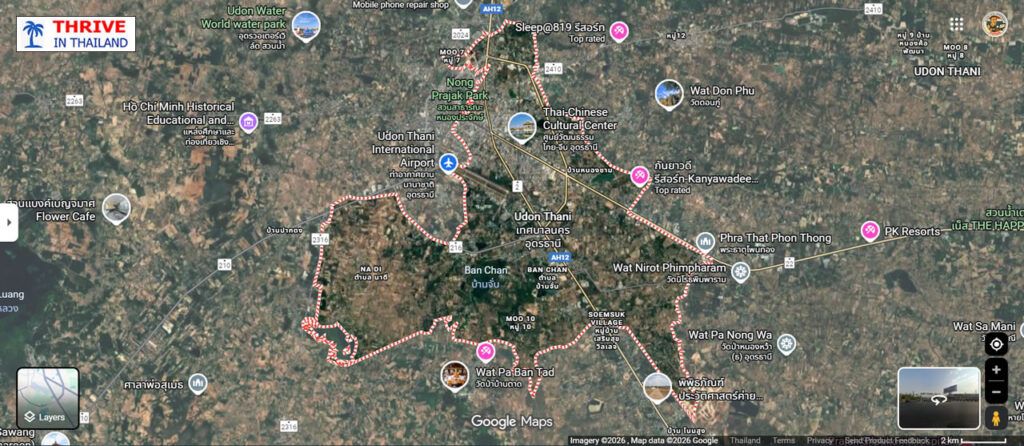
Udon Thani on the Map
To put things into perspective, Udon Thani sits in Thailand’s Upper Isan region, roughly 560 kilometers northeast of Bangkok. The city spreads out around its central districts and airport, with Nong Prajak Park marking one of the most recognizable landmarks. Thanks to its role as a regional hub, major roads and rail lines converge here, making it straightforward to reach from both Bangkok and nearby provinces.
Click the image below to open Udon Thani’s location in Google Maps in a new tab.
Best Time to Visit Udon Thani
Udon Thani can be visited year-round, but the experience changes noticeably with the seasons, especially in Northeast Thailand’s more extreme climate.
- November to February is generally the most comfortable time to be here. Days are warm but manageable, evenings are cooler, and rainfall is minimal. This period suits sightseeing, market visits, and day trips, and it’s when the city feels most relaxed and walkable.
- March to May is the hottest stretch of the year. Temperatures regularly climb into the mid-to-high 30s°C, and outdoor activities can feel draining during the day. That said, daily life continues as normal, and prices for accommodation are often lower. Early mornings and evenings are the best times to be out.
- June to October brings the rainy season. Showers tend to be short but heavy, usually in the afternoon or evening. The upside is greener surroundings, fewer visitors, and a slower pace. Flooding is rarely a major issue in the city itself, making this a perfectly workable time for longer stays.
If you’re planning around local culture, festivals like Songkran (April) and regional Buddhist events add character, but also bring heat, crowds, or occasional travel disruptions. For most visitors and long-stay travelers, late November through February offers the easiest introduction to Udon Thani.
Not sure if it’s a good month to visit?
Use the Monsoon Weather Checker—choose a destination and month to see a clear Go / Iffy / Avoid signal from Thailand’s Meteorological Department climate averages (historical; no forecasts), plus typical rainfall, rainy days, temperature, and a one-line sea conditions note.
How to Get to Udon Thani from Bangkok
For most visitors and long-stay travelers, Bangkok is the main gateway to Udon Thani. Getting there is straightforward, with several reliable options depending on your budget, time, and comfort preferences.
By Plane (Fastest Option)
Flying is the quickest and easiest way to reach Udon Thani. Daily flights operate from Don Mueang Airport (DMK), with a flight time of just over one hour.
- Flight time: ~1 hour 10 minutes
- Typical price: 1,000–2,500 THB one way, depending on season and how early you book
- Airport transfer: 150–300 THB to the city center by taxi or ride-hailing app
📌 This option is ideal if you value speed or are arriving in Bangkok on an international flight and want to continue north without a long overland journey.
By Train (Comfortable & Scenic)
Udon Thani is on the northeastern rail line, with services departing from Krung Thep Aphiwat Central Terminal. Overnight sleeper trains are popular and surprisingly comfortable.
- Travel time: 8–10 hours
- Typical price:
- 3rd class seat: 300–400 THB
- 2nd class air-con seat: 500–700 THB
- 2nd class sleeper: 800–1,200 THB
📌 The train station in Udon Thani is centrally located, making this a convenient option if you arrive early in the morning.
By Bus (Best Budget Choice)
Long-distance buses leave regularly from Mo Chit Bus Terminal in Bangkok. Services range from standard to VIP coaches with reclining seats and onboard snacks.
- Travel time: 8–10 hours
- Typical price: 450–800 THB, depending on comfort level
📌 Buses arrive at Udon Thani Bus Terminal, about a 10–15 minute ride from the city center.
By Car (Flexible but Long)
Driving gives you flexibility if you plan to stop along the way or explore Isan after arrival.
- Driving time: 7–8 hours (traffic dependent)
- Distance: ~560 km
- Estimated cost: 2,000–3,000 THB for fuel and tolls
📌 The main route follows Highway 2 (Mittraphap Road), which is well maintained and easy to navigate.
✅ In short: flying is the fastest, trains offer a relaxed overnight option, buses are the cheapest, and driving works best if you want full independence. For most people, Bangkok → Udon Thani is a simple, well-served journey that rarely requires advance planning beyond booking a ticket.
Getting Around Udon Thani
Udon Thani is a spread-out city, but getting around is generally easy once you understand the local transport options. Most people rely on a mix of short rides and occasional rentals rather than walking everywhere.
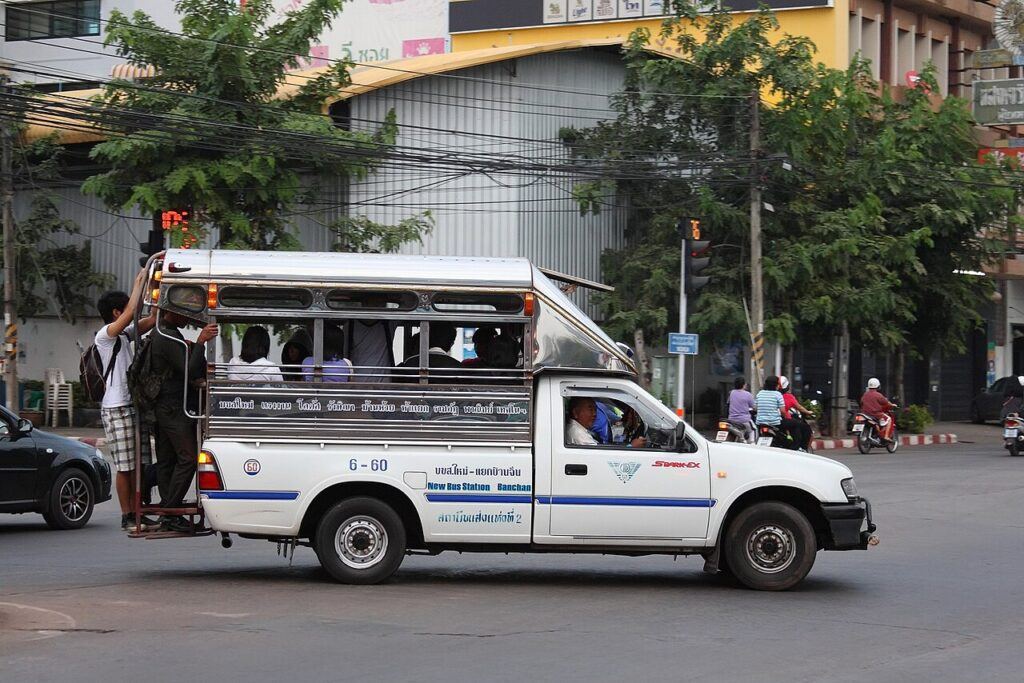
Photo by Ilya Plekhanov on Wikimedia Commons, licensed under CC BY-SA 3.0
Songthaews & Local Transport
Songthaews (shared pickup trucks) operate on fixed routes around the city and are the most common form of local transport for residents. They’re cheap and frequent, though routes aren’t always obvious to first-time visitors.
- Typical fare: 10–20 THB per ride
- Best for: short trips, markets, central areas
- Tip: Tell the driver where you’re going before getting in to avoid confusion
Taxis & Ride-Hailing
Metered taxis are limited, but Grab works reliably in most parts of the city. Prices are reasonable, and this is often the easiest option for newcomers or evening travel.
- Short city rides: 60–120 THB
- Airport to city center: around 150–300 THB
Motorbike & Car Rentals
Renting a motorbike or car makes life much easier if you’re staying longer or want to explore beyond the city center.
- Motorbike rental: 200–300 THB per day
- Car rental: from 1,000 THB per day
📌 An international or Thai driver’s license is technically required, and police checkpoints do happen, though they’re generally low-key compared to tourist hotspots.
Walking & Practical Tips
Some central areas, parks, and markets are walkable, but sidewalks can be uneven or disappear entirely. For daily life, most residents combine short walks with rides.
- Traffic is generally calmer than in major cities
- Helmets are strongly recommended for motorbikes
- Night driving is straightforward, with well-lit main roads
✅ Overall, Udon Thani isn’t a city where you need to plan transport obsessively. Once you settle in, moving around becomes routine and inexpensive, which is part of the appeal for long-stay visitors and expats.
Top Things to Do in Udon Thani
Udon Thani isn’t about ticking off headline attractions. The appeal lies in everyday routines, local spaces, and simple pleasures that make the city comfortable to live in or spend time exploring at an unhurried pace.

Photo by Ilya Stefan Fussan on Wikimedia Commons, licensed under CC BY-SA 3.0
Relax at Nong Prajak Park
This large lake park is the city’s social heart. Locals come here early in the morning and again in the evening to walk, jog, cycle, or simply sit by the water. Food stalls pop up later in the day, and weekends are especially lively without feeling crowded.
Explore Local Markets
Markets are a big part of daily life here. From morning fresh markets to evening street-food hubs, they’re where you get a real sense of Isan culture.
- UD Town Market – easygoing, clean, and popular with both locals and expats
- Night markets around the city – great for casual dinners and people-watching
Visit Temples Locals Actually Use
Rather than grand sightseeing temples, Udon Thani’s wats feel lived-in and practical. They’re calm places to visit during the day and part of the city’s rhythm rather than tourist stops.
Café-Hopping & Daily Errands
Udon Thani has a surprisingly good café scene, with independent coffee shops scattered around town. Pair that with shopping malls, gyms, and supermarkets, and you get a clear picture of how everyday life here works.
Take It Slow
One of the best things to do in Udon Thani is simply settle into the pace. Walk the park in the morning, eat well, run errands without stress, and enjoy evenings that are social but never overwhelming. That quiet consistency is exactly why many people choose to stay longer than planned.
Best Photo Spots & Scenic Viewpoints
Udon Thani isn’t a city of dramatic skylines or sweeping viewpoints. Its photography appeal comes from everyday scenes, green spaces, temples, and local life. These spots capture the city’s character best, especially if you enjoy relaxed, documentary-style shots.
Nong Prajak Park & Lake (Everyday City Life)
📌 Calm city scenes with lake reflections, joggers, food stalls, and relaxed local routines.
✅ Best time: Early morning (06:00–08:00) or sunset (17:30–18:30)
Shot ideas: Lake reflections, walkers and cyclists, food vendors setting up, wide park scenes
Crowd strategy: Mornings are quiet; evenings are livelier but still manageable
Shooting notes: Handheld works well; tripod useful near the water at sunrise
Equipment tip: Standard zoom or short telephoto for candid lifestyle shots
Drone notes: Not recommended; busy public area
Difficulty: ★☆☆☆☆ Easy
📍 Google Maps: Nong Prajak Park, Udon Thani
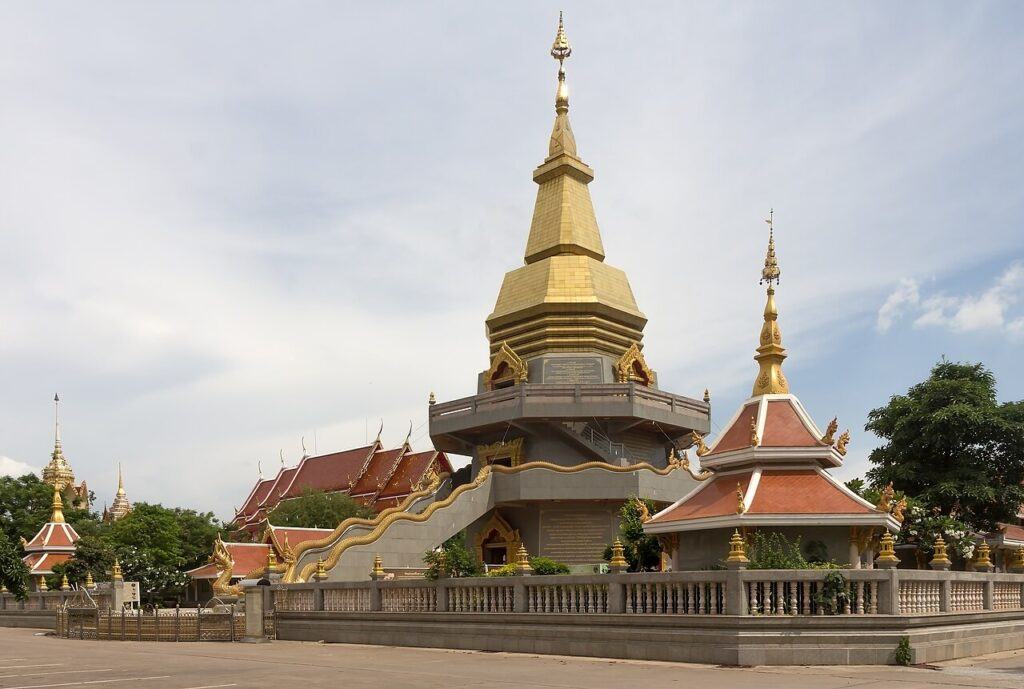
Wat Phothisomphon (Local Temple Atmosphere)
📌 Elegant temple architecture with a calm, lived-in feel rather than tourist crowds.
✅ Best time: Morning (08:00–10:00)
Shot ideas: Temple details, prayer moments, wide courtyard compositions
Crowd strategy: Visit on weekdays for fewer people
Shooting notes: Be discreet; avoid photographing worshippers up close
Equipment tip: Wide-angle lens for architecture; prime lens for details
Drone notes: ❌ Not allowed around temples
Difficulty: ★☆☆☆☆ Easy
📍 Google Maps: Wat Phothisomphon, Udon Thani
UD Town Market (Evening Street Life)
📌 Casual street scenes with food stalls, cafés, lights, and social energy.
✅ Best time: Early evening (18:00–19:30)
Shot ideas: Street food preparation, neon signs, people dining, candid moments
Crowd strategy: Arrive early before peak dinner rush
Shooting notes: Handheld shooting works best; move with the flow
Equipment tip: Fast lens (f/1.8–f/2) for low light
Drone notes: ❌ Not suitable
Difficulty: ★☆☆☆☆ Easy
📍 Google Maps: UD Town, Udon Thani
Residential Streets & Local Shops (Authentic Details)
📌 Everyday Isan life with wooden houses, shrines, street stalls, and quiet neighborhoods.
✅ Best time: Late afternoon (16:30–17:30)
Shot ideas: Shopfronts, street details, bicycles, small shrines
Crowd strategy: Wander side streets away from main roads
Shooting notes: Be respectful; ask before photographing people directly
Equipment tip: Lightweight prime lens for discretion
Drone notes: ❌ Not appropriate in residential areas
Difficulty: ★☆☆☆☆ Easy
📍 Google Maps: Central Udon Thani (explore on foot)
📌 Udon Thani rewards photographers who slow down. The best images come from observing daily life rather than chasing landmarks — a walk, a coffee stop, or an evening market often delivers more character than any “must-see” spot.
What & Where to Eat in Udon Thani
Eating in Udon Thani is simple, affordable, and deeply local. This is Isan food country, where meals are casual, portions are generous, and eating out is part of daily routine rather than a special occasion. You’ll find good food everywhere — from morning markets to evening street stalls and no-nonsense restaurants locals rely on.
✅ Instead of chasing “must-eat” lists, it’s better to know where people actually eat and what to order.
Where to Eat in Udon Thani (Practical Picks)
| Place | Type | What to Try | Typical Price | Why It’s Worth It |
|---|---|---|---|---|
| UD Town | Night market & food zone | Som tam, grilled chicken, moo ping | 40–70 THB | Easy introduction to Isan food with a relaxed evening atmosphere |
| Local fresh markets | Morning / daytime markets | Breakfast dishes, grilled pork, fruit | 30–60 THB | Authentic daily eating at local prices |
| VT Nam Nueng | Vietnamese sit-down restaurant | Vietnamese set meals with herbs | 120–200 THB | Well-known local institution, good for groups |
| Isan-style local restaurants | Casual Thai | Larb, nam tok, gai yang | 60–120 THB | Reliable everyday meals with fast service |
| Independent cafés | Café & casual dining | Coffee, light meals, desserts | 80–180 THB | Comfortable spots popular with expats and locals |
| Japanese & Korean restaurants | Sit-down international | Set meals, BBQ, noodles | 180–350 THB | Good quality and value, popular with locals |
What to Order (Isan Basics You’ll See Everywhere)
- Som Tam (Papaya Salad) – Spicy, sour, salty. Ask for mai phet if needed.
- Larb – Minced meat salad with herbs and lime (pork or chicken most common).
- Gai Yang – Charcoal-grilled chicken, usually with sticky rice.
- Nam Tok – Grilled meat salad with roasted rice powder.
- Sticky Rice (Khao Niao) – Eaten by hand and shared.
📌 These dishes are available across the city and rarely cost more than 60–100 THB per portion.
Cafés & Western Food
Udon Thani has a solid café culture for a provincial city. Independent coffee shops are scattered around town and double as casual meeting spots or quiet places to work. Western food is easy to find too — burgers, pizza, pasta, and bakeries are common and reasonably priced.
- Coffee: 50–90 THB
- Western mains: 150–300 THB
📌 Nothing flashy, but consistently good.
Eating Out: Practical Tips
- Dinner often starts early (around 5–6 pm)
- Cash is still preferred at markets and small eateries
- Food is meant to be shared — ordering several dishes is normal
- Spice levels can be intense; say mai phet if unsure
- Portions are generous and value for money is excellent
✅ Udon Thani isn’t a “food destination” in the Instagram sense — but for everyday eating, it’s one of the easiest cities in Thailand to settle into. Once you find a few regular spots, eating well becomes effortless and inexpensive.
Nightlife & Social Scene in Udon Thani
Nightlife in Udon Thani is low-key and local, centered more around casual bars, food zones, and social meetups than late-night clubbing. Evenings usually start early, and most places wind down by midnight.
The most social atmosphere is around UD Town, where bars, cafés, and food stalls create an easygoing evening scene. It’s popular with locals, expats, and visitors who want to eat, have a drink, and chat without loud music or crowds. Elsewhere in the city, you’ll find small neighborhood bars and live-music venues that cater mainly to regulars.
Udon Thani also has a modest but established expat community, with informal meetups and social groups rather than organized nightlife. It’s the kind of place where conversations happen over dinner or a quiet drink, not on a packed dance floor.
📌 If you’re looking for energetic nightlife or late-night parties, Udon Thani will feel subdued. If you prefer relaxed evenings and a social scene that fits everyday life, it does the job quietly and comfortably.
Where to Stay in Udon Thani
Choosing where to stay in Udon Thani is less about views and more about convenience, quiet streets, and daily routines. The city is spread out, so location matters if you want to keep transport costs and travel time down.
City Center & Nong Prajak Park Area
This is one of the most practical areas for first-time visitors and long-stay guests alike. You’re close to the park, cafés, markets, and everyday services, and it’s easy to get around by Grab or motorbike.
- Best for: walkable routines, morning exercise, cafés
- Accommodation types: mid-range hotels, serviced apartments, condos
- Typical prices: 800–1,800 THB per night (hotels), lower for monthly stays
Near Shopping Malls & Transport Hubs
Staying near major malls and transport corridors offers convenience, especially if you don’t plan to rent a vehicle. These areas are busier during the day but quiet down in the evenings.
- Best for: short stays, easy shopping, dining options
- Accommodation types: hotels, serviced apartments
- Typical prices: 700–1,500 THB per night
Residential Neighborhoods (Longer Stays)
If you’re staying a few weeks or longer, quieter residential areas slightly outside the center offer better value and a more local feel. Many expats prefer these zones for space and privacy.
- Best for: long stays, retirees, low-noise living
- Accommodation types: condos, houses
- Typical monthly rent: from 6,000–12,000 THB for basic condos, more for larger homes
To make planning easier, here are some real-world accommodation examples in Udon Thani, covering short stays and longer-term options. Prices are indicative and vary by season.
| Property | Type | Best Area | Typical Price | Why It’s Worth It |
|---|---|---|---|---|
| Centara Hotel & Convention Centre Udon Thani | Full-service hotel | Central / near malls | ~1,500–2,200 THB / night | Reliable comfort and facilities; great for short stays |
| Sala Udon Hotel | Boutique hotel | City center | ~1,800–2,800 THB / night | Stylish option with a calm vibe; good for couples |
| The Asty Hotel & Residence | Mid-range hotel / residence | Near UD Town | ~900–1,500 THB / night | Convenient location for food and evenings out |
| Udee Bangkok Hostel / budget stays | Budget | Central areas | ~500–900 THB / night | Simple, clean, and affordable for short stays |
| Serviced apartments (local) | Long-stay rental | Near Nong Prajak / residential | ~6,000–12,000 THB / month | Best value for longer stays; often includes kitchenette |
| Condo rentals (monthly) | Long-stay (condo) | Residential neighborhoods | ~7,000–15,000 THB / month | More privacy and space; good if you want a routine |
Booking Tips
- Short stays are easiest to book through hotel platforms
- Monthly rentals are often cheaper when arranged locally
- Ask about Wi-Fi speed and water pressure before committing long term
- Locations matter more than amenities in this city
✅ Udon Thani rewards practical choices. A comfortable, well-located place to stay makes daily life simple — and once that’s sorted, the city quickly starts to feel familiar.
Shopping & Local Markets in Udon Thani
Shopping in Udon Thani is practical and low-pressure, focused on everyday needs rather than souvenirs or luxury brands. Most residents mix modern malls with local markets, depending on what they need that day.
Malls & Modern Shopping
For air-conditioned comfort, groceries, and international brands, the city’s main malls cover almost everything.
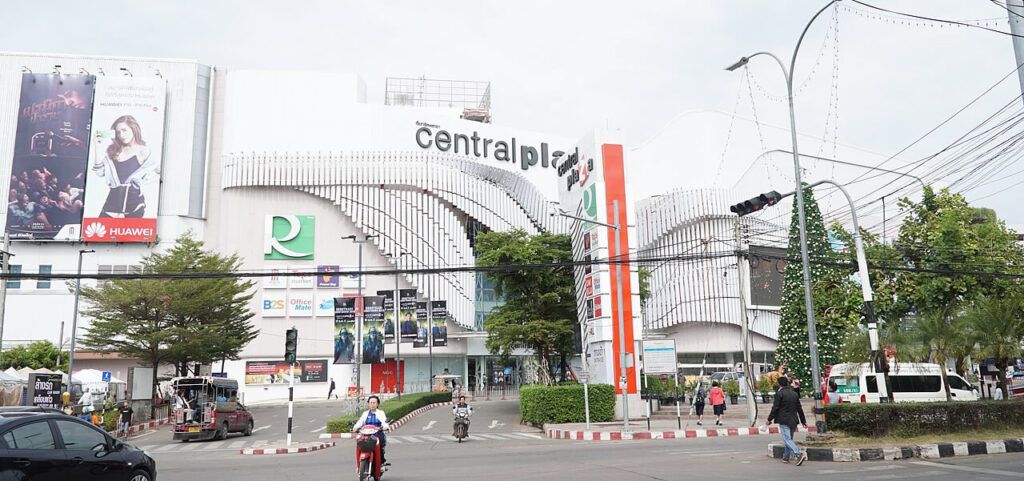
Photo by Z3144228 on Wikimedia Commons, licensed under CC BY-SA 4.0
- Central Plaza Udon Thani – The city’s main shopping hub with supermarkets, international chains, cafés, cinemas, and restaurants. It’s convenient for errands and casual dining rather than browsing boutiques.
- Smaller shopping complexes and big-box stores are scattered around town, making electronics, home goods, and clothing easy to find without long travel.
Good for: one-stop shopping, dining, escaping the heat
Prices: similar to mid-sized Thai cities, generally lower than Bangkok
Local Markets (Everyday Essentials)
Local markets are where Udon Thani feels most alive. They’re part of daily routines and often far more useful than malls.
- UD Town – A relaxed open-air area with shops, food stalls, and casual market-style vendors, especially popular in the evenings.
- Fresh markets around residential neighborhoods sell fruit, vegetables, meat, cooked food, and household items at local prices.
What to buy: fresh produce, street food, snacks, simple clothing
Typical prices: very affordable; bargaining is minimal and usually unnecessary
Night Markets & Casual Browsing
Night markets in Udon Thani are more about eating and socializing than serious shopping. Expect food stalls, drinks, and small vendors selling clothes or accessories rather than large souvenir sections.
They’re ideal for:
- informal dinners
- evening walks
- casual people-watching
Practical Shopping Tips
- Cash is still preferred at markets and smaller stalls
- Malls and supermarkets accept cards without issue
- Markets tend to close earlier than in tourist cities
- Shopping here is functional, not flashy — and that’s part of the appeal
✅ Shopping in Udon Thani fits the city’s overall rhythm: straightforward, affordable, and easy to integrate into daily life without planning around crowds or tourist zones.
Day Trips & Nearby Attractions
One of Udon Thani’s biggest advantages is its location. While the city itself is calm and residential, it works extremely well as a base for exploring Northeast Thailand, with several worthwhile trips that are easy to do in half a day or a full day.
Ban Chiang (Half Day)
A short drive from the city, Ban Chiang is one of Thailand’s most important archaeological sites and a UNESCO World Heritage Site. It offers a quiet but fascinating look at prehistoric settlements, pottery, and early human culture in the region.
- Distance: ~50 km east of Udon Thani
- Time needed: 2–3 hours
- Best for: culture, history, easy educational trip
- Tip: Combine the museum with a walk around the village for context
Phu Foi Lom Forest Park (Local Escape, Half Day)
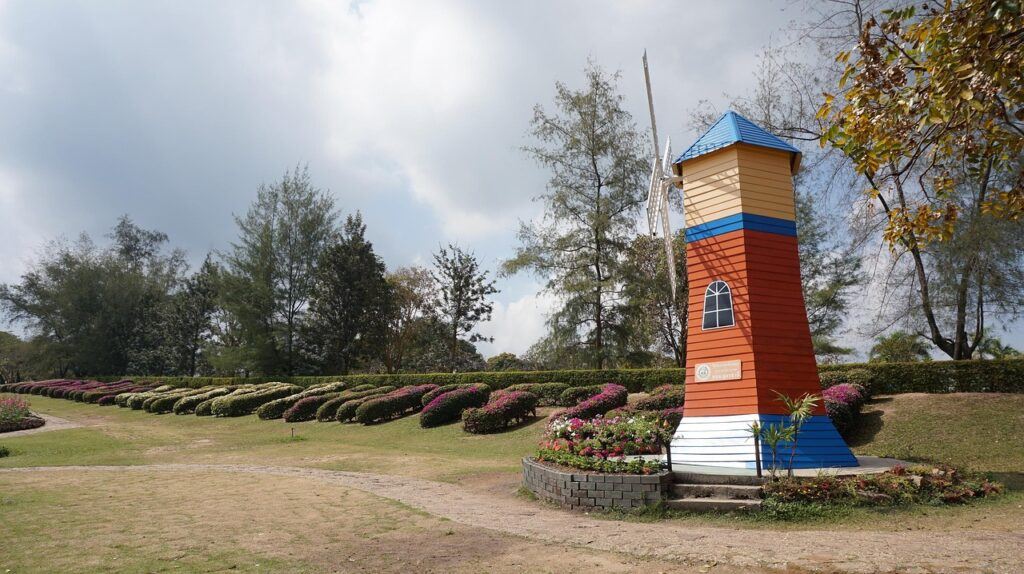
A forested hill area just outside Udon Thani, Phu Foi Lom is popular with locals looking for cooler air, viewpoints, and a quiet break from the city. It’s more about nature and atmosphere than major sights.
- Distance: ~40 minutes from the city
- Best season: November to February
- Best time: Morning or late afternoon
- Tip: Ideal for a casual visit; don’t expect a structured attraction
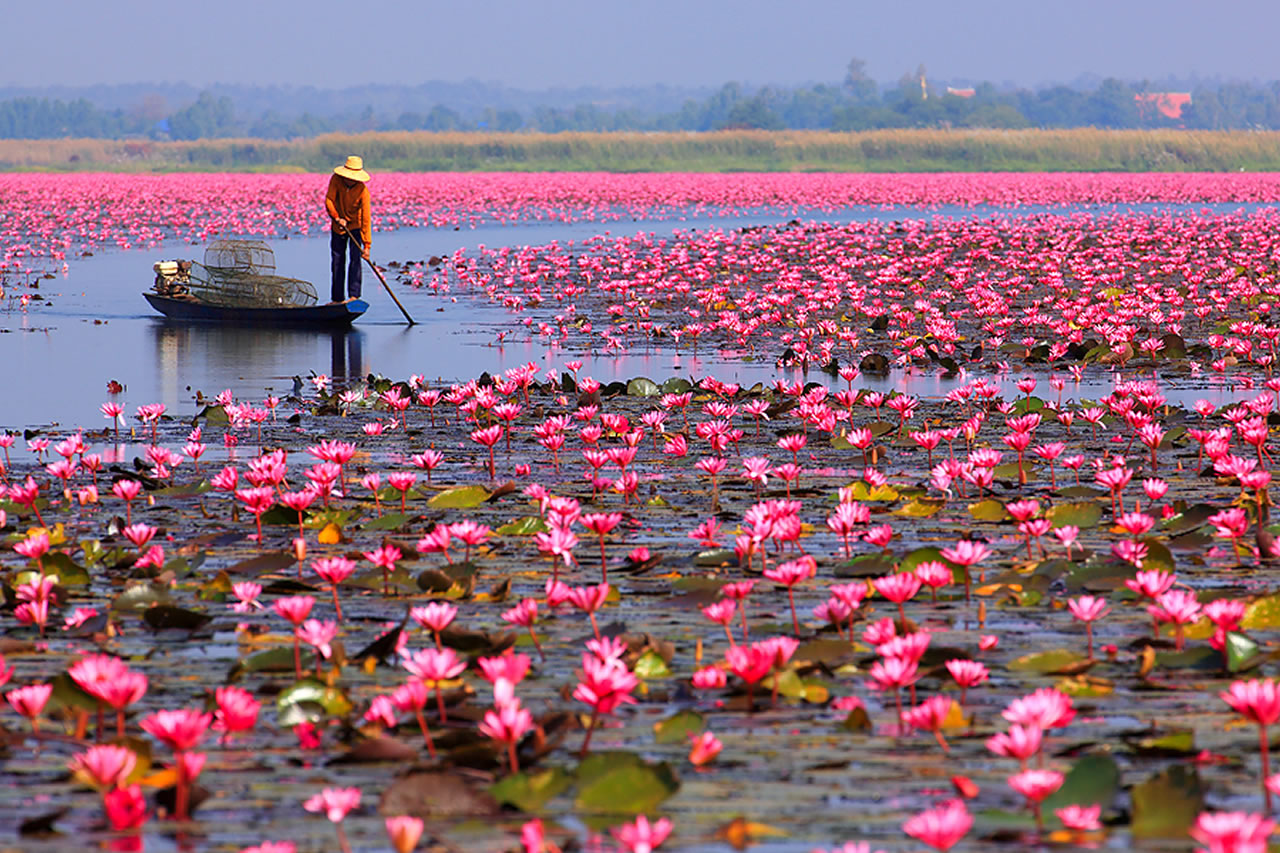
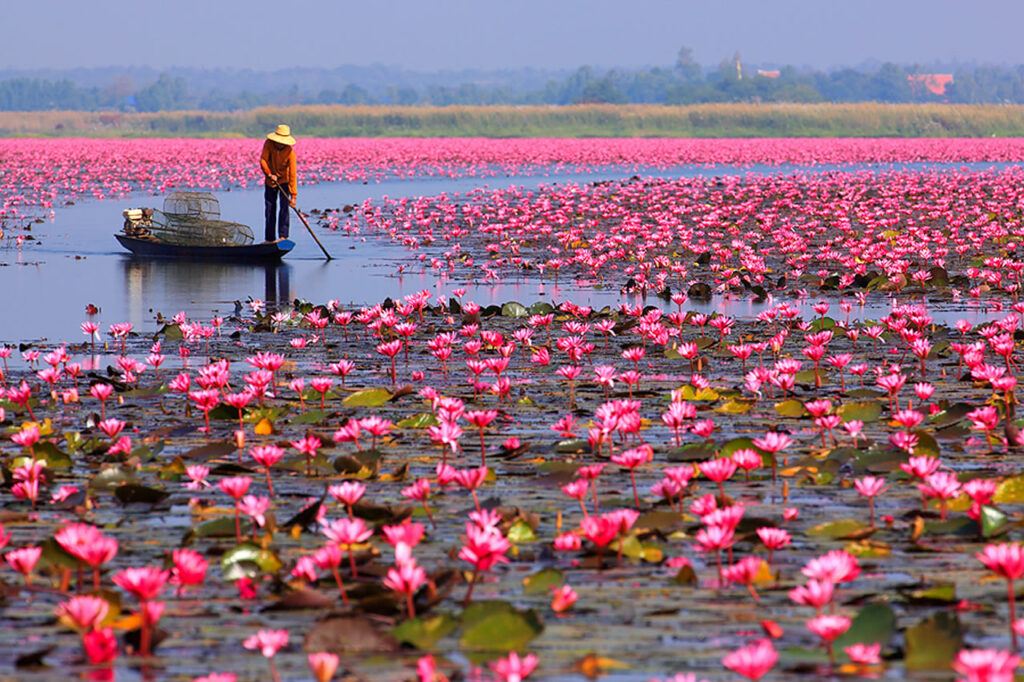
Red Lotus Sea (Seasonal, Half Day)
Photo by Unknown on Wikimedia Commons, licensed under CC BY 4.0
Known locally as Talay Bua Daeng, this lake fills with blooming red lotus flowers during the cooler months. It’s one of the most photogenic natural sights in the province.
- Distance: ~45 minutes from the city
- Best season: December to February
- Best time: Early morning (boat rides start early)
- Tip: Go on a weekday to avoid crowds
Nong Khai (Full Day)
Sitting on the Mekong River near the Lao border, Nong Khai offers river views, temples, cafés, and a more relaxed border-town atmosphere. It’s an easy change of pace from Udon Thani.
- Distance: ~55 km north
- Time needed: Half to full day
- Highlights: Mekong riverfront, markets, temples
- Tip: Late afternoon is best for riverside walks and dinner
Wat Pa Phu Kon (Half to Full Day)
Set deep in forested hills, this striking blue-and-white temple is one of the most impressive in the region. The drive itself is scenic and part of the experience.
- Distance: ~120 km
- Time needed: Half day minimum
- Best for: temples, nature, quiet surroundings
- Tip: Dress modestly and bring water; facilities are limited
Nearby Isan Towns & Countryside (Flexible)
If you have your own transport, small towns and rural areas around Udon Thani are easy to explore without a strict plan. These trips aren’t about attractions but about seeing everyday Isan life — rice fields, local markets, and roadside eateries.
- Best for: slow travel, photography, local insights
- Time needed: as little as a few hours
📌 Udon Thani works best when you treat it as a central base rather than a sightseeing destination. With several meaningful trips close by, it offers variety without the hassle of constantly changing accommodation.
Itineraries for Udon Thani
These itineraries are designed for easy pacing and real-life travel, not box-ticking. Udon Thani works best when you keep days simple and build around meals, short drives, and downtime.
Photo by Stefan Fussan on Wikimedia Commons, licensed under CC BY SA 3.0
1-Day Udon Thani City Loop (Easy & Local)
📌 A relaxed introduction to daily life in Udon Thani.
What you’ll do:
- Morning: Walk or jog around Nong Prajak Park + breakfast at a nearby café
- Late morning: Visit Wat Phothisomphon or run errands around the city center
- Lunch: Casual Thai or Vietnamese food (VT Nam Nueng or local Isan spot)
- Afternoon: Mall stop at Central Plaza Udon Thani (coffee, AC, groceries)
- Evening: Dinner and a drink at UD Town, then an early night
Typical spend: ฿800–฿1,500 per person
✅ Best for: short stays, first-time visitors, slow travel days
2-Day Udon Thani + Ban Chiang (Balanced)
📌 City comfort with one cultural highlight nearby.
Day 1 – Udon Thani City Life
- Follow the 1-day city loop above
- Optional evening bar or live music if you feel like it
Day 2 – Ban Chiang Half-Day Trip
- Morning: Drive or tour to Ban Chiang (museum + village)
- Lunch: Local restaurant near Ban Chiang
- Afternoon: Return to Udon Thani, café time or rest
- Evening: Simple dinner near your accommodation
Typical spend: ฿1,500–฿2,500 per person (depending on transport)
✅ Best for: culture lovers, relaxed weekends, couples
3-Day Udon Thani Regional Base (No Rush)
📌 Udon Thani as a base for exploring Isan without changing hotels.
Day 1 – City & Routine
- Nong Prajak Park, cafés, temples, markets
- Easy evening at UD Town
Day 2 – Red Lotus Sea (Seasonal) or Nong Khai
- Option A (Dec–Feb): Early boat ride at Red Lotus Sea, back by lunch
- Option B (Year-round): Full day in Nong Khai (Mekong riverfront + dinner)
Day 3 – Flexible Day
- Late breakfast
- Shopping, errands, or short countryside drive
- Pack, relax, or prepare for onward travel
Typical spend: ฿2,500–฿4,000 per person
✅ Best for: slow travelers, longer stays, people testing the city
📌 Udon Thani itineraries work best when you avoid overplanning. One main activity per day is usually enough — the rest naturally fills itself with food, cafés, and downtime.
Cost Snapshot: Udon Thani
Udon Thani is noticeably cheaper than Thailand’s major cities, especially when it comes to food, accommodation, and daily transport. It’s a place where everyday expenses stay predictable, which is why many long-stay visitors and retirees find it comfortable financially.
Below is a realistic snapshot of what you can expect to spend.
Typical Daily Costs in Udon Thani
| Expense | Typical Cost | Notes |
|---|---|---|
| Street food meal | 40–70 THB | Isan dishes, markets, food zones |
| Local restaurant meal | 60–120 THB | Casual Thai or Vietnamese food |
| Western / international meal | 150–300 THB | Cafés, Japanese, Korean restaurants |
| Coffee | 50–90 THB | Independent cafés and chains |
| Grab / taxi (short ride) | 60–120 THB | Typical in-city ride |
| Motorbike rental | 200–300 THB / day | Usually cheaper on weekly/monthly deals |
| Mid-range hotel | 900–1,500 THB / night | Comfortable hotels in central areas |
| Monthly condo rent | 6,000–12,000 THB / month | Basic units; higher for newer buildings |
Estimated Daily Budgets
- Budget traveler: ฿900–฿1,200
(street food, basic accommodation, local transport)
- Mid-range traveler: ฿1,500–฿2,500
(comfortable hotel, mixed dining, occasional Grab rides)
- Long-stay / expat style: ฿1,200–฿2,000
(monthly rental, eating out regularly, low transport costs)
Value Compared to Other Cities
Compared to Bangkok, Chiang Mai, or beach destinations, Udon Thani offers lower rents, cheaper food, and fewer “tourist premiums.” What you trade away in entertainment options, you gain in affordability and daily comfort.
✅ Udon Thani isn’t about extreme budget travel — it’s about stable, low-friction living where costs stay manageable without constant trade-offs.
Want a realistic Thailand trip budget?
Use the Thailand Travel Cost Calculator — just enter your destinations, trip length, and travel style to get instant, accurate per-person and group trip costs in both THB and USD.
📌 Want a deeper breakdown of what things cost across Thailand by region and style?
Read the full Cost of Travel in Thailand guide.
Digital Nomad Friendliness in Udon Thani
Udon Thani is workable for remote work, but it’s not a digital nomad hotspot in the usual sense. Internet quality across the city is generally reliable, with fiber connections common in hotels, condos, and many cafés. For focused, quiet work, it does the job well.
What’s missing is a strong coworking ecosystem or nomad community. There are few dedicated coworking spaces, and networking events are rare. Most people working remotely here are long-stay expats, freelancers with established routines, or semi-retired professionals rather than short-term nomads hopping between cities.
Good fit if you:
- prefer quiet routines and low living costs
- don’t rely on coworking or frequent meetups
- plan to stay longer than a few weeks
Less ideal if you:
- want a lively nomad scene or regular events
- depend on coworking spaces for structure
📌 In short, Udon Thani suits remote workers who value stability over buzz.
Family-Friendliness in Udon Thani
Udon Thani is a safe, calm, and practical city for families, especially those with older children or a preference for low-key living. Traffic is lighter than in major cities, neighborhoods are generally quiet, and public spaces like Nong Prajak Park are well used by local families.
That said, it’s not a major international-school hub. Families looking for a wide choice of international curricula or large expat family communities may find options limited compared to Bangkok or Chiang Mai.
Strengths for families:
- relaxed pace of life
- affordable housing and food
- parks, malls, and everyday services close by
Things to consider:
- limited international school choice
- fewer child-focused attractions than tourist cities
📌 For families prioritizing simplicity, safety, and affordability, Udon Thani can work well. For those needing extensive international schooling options, it’s better seen as a quieter alternative rather than a primary relocation hub.
Local Services & Emergency Info
Udon Thani is well equipped when it comes to everyday services and emergency care, especially for a provincial city. Most essentials are easy to access, and serious medical or administrative issues can usually be handled locally without needing to travel to Bangkok.
Emergency Numbers (Thailand-Wide)
- Police: 191
- Tourist Police: 1155 (English support available)
- Ambulance / Medical Emergency: 1669
- Fire Department: 199
📌 Save these numbers on your phone if you plan to stay more than a few days.
Hospitals & Medical Care
Udon Thani has several reputable hospitals offering both public and private care. Private hospitals are generally preferred by foreigners for shorter wait times and English-speaking staff.
- Bangkok Hospital Udon – Modern private hospital with international-standard facilities and English-speaking doctors.
- Udon Thani Hospital – Large government hospital handling emergencies and specialist care, though wait times can be longer.
📌 For private hospitals, bring your passport and insurance details. Payment is usually required upfront unless your insurer has a direct billing agreement.
Pharmacies
Pharmacies are widespread across the city, including inside malls and along major roads. Many medications that require prescriptions in other countries are available over the counter in Thailand.
- Most pharmacists speak basic English
- Bring the original medication box or name if possible
- 24-hour pharmacies are available near major hospitals
Immigration Office
For visa extensions, reporting, and other immigration matters, Udon Thani has a local immigration office serving the province.
- Udon Thani Immigration Office
- Services include visa extensions, 90-day reporting, and general inquiries
- Arrive early in the morning to reduce waiting time
Police & Tourist Assistance
In addition to regular police stations, the Tourist Police are available for assistance with lost items, minor disputes, or travel-related issues. They are generally more accustomed to dealing with foreigners.
Practical Safety Notes
- Udon Thani is considered safe by Thai standards, with low violent crime
- Use normal precautions with valuables, especially at markets
- Traffic accidents are the most common risk; helmets are strongly recommended for motorbikes
- Keep a photo of your passport on your phone for everyday use
📌 For most visitors and long-stay residents, Udon Thani offers a reassuring level of infrastructure. Knowing where to go and who to call makes day-to-day life smoother — and in emergencies, response is generally quick and reliable.
FAQs About Udon Thani
These questions focus on common search queries that aren’t fully answered above, keeping this section useful without repeating earlier content.
Is Udon Thani a good base for exploring Isan?
Yes. Udon Thani works very well as a regional base, with good transport links and several worthwhile day trips nearby. Many travelers stay here and explore the surrounding province rather than moving accommodation frequently.
Can foreigners live long-term in Udon Thani?
Yes. Many foreigners live here long term, especially retirees and expats with Thai family connections. While the expat scene is smaller than in major cities, day-to-day life is straightforward and affordable.
Do people in Udon Thani speak English?
English is limited outside hotels, private hospitals, and malls. Basic Thai goes a long way, especially for markets, transport, and local services. Most long-stay foreigners pick up enough Thai to manage daily life comfortably.
Is Udon Thani boring?
That depends on what you’re looking for. If you want nightlife, attractions, and constant stimulation, it may feel quiet. If you value routine, affordability, and a calm pace of life, many people find it pleasantly balanced rather than boring.
How many days should you spend in Udon Thani?
For visitors, 1–3 days is usually enough to see the city and take one nearby trip. For longer stays, Udon Thani is better approached as a living base rather than a sightseeing destination.
Related Guides & Further Reading
Travel in Thailand is easier when you have the right balance of practical advice and destination inspiration. Below you’ll find useful travel resources to help you prepare smoothly, plus nearby destinations worth adding to your journey.
Thailand Travel Essentials: Plan Smarter, Travel Easier
Need tips on visas, health, culture, or everyday logistics? My hub brings all the key guides together in one place: Explore the Thailand Travel Guide
Your Next Thai Adventure Awaits
Looking for where to go next? These nearby or complementary places pair well with your current destination and are worth your time in the Land of Smiles.
- Hat Yai Travel Guide: Best Things to Do, Where to Eat, Shopping & Day Trips
- Chiang Rai Travel Guide: Best Temples & Nature, Where to Stay & How to Get There
- Ayutthaya Travel Guide: Temples, History & How to Visit Thailand’s Ancient Capital
💬 Have tips, updates, or firsthand experience in Udon Thani? Add a comment — it helps other readers plan better.