
Paying in Thailand is easy right up until it suddenly isn’t.
One day you’re tapping a card at a mall in Bangkok. The next day you’re standing at a street food stall, a small clinic, or a landlord’s office where it’s cash only, the QR code won’t work for you, and the ATM just charged you an extra fee you didn’t expect.
That’s why “the best payment method” in Thailand is rarely just one method. For most foreigners, the smartest setup is a mix of options that covers everyday spending, larger payments, and emergencies without bleeding money through poor exchange rates, ATM charges, or hidden card markups.
In this guide, I’ll break down the most practical payment methods foreigners use in Thailand (cash, Thai bank accounts, foreign cards, and mobile payments), the fees people commonly overlook, and a simple way to choose the right setup depending on how long you’re staying and how you live.
The Main Payment Options Foreigners Use in Thailand
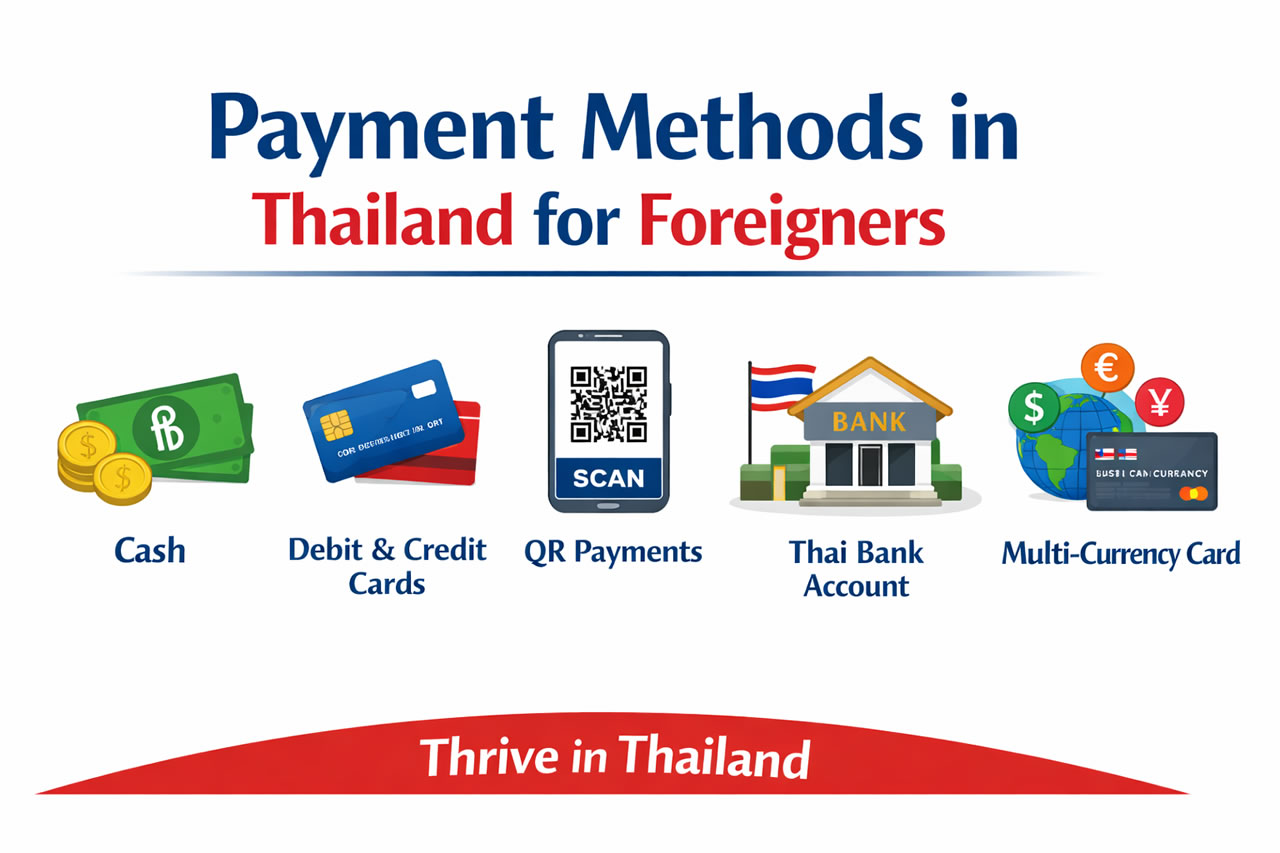
Thailand doesn’t rely on a single payment system. Instead, everyday transactions are spread across several methods, and foreigners usually end up using more than one to get through daily life smoothly.
Below are the main payment options you’ll encounter, along with where each one works best and where it can fall short.
Cash (Still Essential)
Despite Thailand’s rapid adoption of digital payments, cash remains essential in many everyday situations. Street food stalls, local markets, small shops, taxis, and informal services often accept cash only.
Cash is also commonly used for:
- Small medical clinics and pharmacies
- Local repair services
- Monthly rent in private rentals
- Tips or informal payments
📌 The downside is convenience. Carrying cash means planning ahead, dealing with ATM fees if you withdraw frequently, and having no record of spending unless you track it yourself. Still, for daily life in Thailand, cash is something foreigners can’t completely avoid.
Thai Bank Account & Local Debit Card
For foreigners staying longer than a short visit, a Thai bank account quickly becomes the most practical payment foundation. A local account allows you to withdraw cash without the standard foreign-card ATM fee and gives you access to Thailand’s mobile banking ecosystem.
With a Thai bank account, you can:
- Pay rent and utilities by bank transfer
- Use a local debit card for in-store payments
- Access mobile banking apps in English
- Use PromptPay for QR payments at many shops and services
📌 Opening an account depends on your visa status and the bank branch, but once set up, it simplifies daily payments significantly and reduces ongoing fees.
Foreign Debit & Credit Cards
Foreign cards are widely accepted at hotels, shopping malls, supermarkets, chain restaurants, and online platforms. They’re convenient, familiar, and useful when you first arrive.
However, foreign cards come with trade-offs:
- Foreign ATM withdrawals usually incur a flat ฿220 local fee per transaction
- Many cards apply foreign exchange markups
- Dynamic currency conversion can silently increase costs if you’re not careful
📌 Foreign cards work best as a backup or short-term solution, rather than as your primary payment method in Thailand.
QR & Mobile Payments
Thailand uses QR payments extensively, primarily through the PromptPay system. Locals pay everything from meals to utility bills by scanning a QR code with their banking app.
For foreigners, access is more limited. PromptPay is typically linked to a Thai bank account and phone number, which means tourists and short-term visitors often can’t use it directly. Some international wallets work for online payments, but they don’t replace Thailand’s domestic QR system.
📌 QR payments are incredibly convenient once you’re set up locally, but they’re not a universal solution for foreigners without a Thai bank account.
Common Fees Foreigners Often Overlook
Many payment problems in Thailand don’t come from using the wrong method, but from not noticing the small fees that quietly add up over time. Individually, they may seem minor. Combined, they can cost you far more than expected, especially if you rely on foreign cards or frequent ATM withdrawals.
Here are the most common ones foreigners run into.
Foreign Card Exchange Rate Markups
When you pay with a foreign debit or credit card, the exchange rate you get isn’t always as good as it looks. Some banks add a hidden markup on top of the real exchange rate, even if they advertise “low” or “no” foreign transaction fees.
In addition, you may be asked whether you want to pay in Thai baht or your home currency. Choosing your home currency usually triggers dynamic currency conversion, which almost always results in a worse rate. Paying in Thai baht is usually the safer option.
ATM Withdrawal Fees
Withdrawing cash using a foreign card in Thailand comes with a flat local ATM fee, currently around ฿220 per transaction. This fee applies regardless of the amount you withdraw and sits on top of any fees charged by your home bank.
📌 Withdrawing small amounts frequently is one of the fastest ways to waste money. Fewer, larger withdrawals usually reduce the overall impact of ATM fees.
Bank and Network Fees
Beyond local ATM fees, additional costs can come from:
- Your home bank’s foreign withdrawal or transaction fees
- Card network fees applied by Visa or Mastercard
- Limits on free withdrawals or fee-free spending per month
📌 These fees are easy to miss because they don’t always appear immediately, and they’re often listed in fine print.
Payment Limits and Declines
Some foreign cards work well in Thailand until they suddenly don’t. Daily limits, security blocks, or regional restrictions can cause payments or withdrawals to fail without warning.
This is why relying on a single payment method can be risky. Having at least one backup option helps avoid awkward or stressful situations when a card is declined.
Comparing Payment Methods in Everyday Life
Each payment method in Thailand works well in certain situations and poorly in others. The key is understanding where each one fits, rather than looking for a single “best” option that covers everything.
To make the differences clearer at a glance, here’s a simple comparison of the main payment methods foreigners use in Thailand and where each one works best.
| Payment Method | Best For | Main Advantages | Common Drawbacks |
|---|---|---|---|
| Cash | Street food, markets, small shops | Widely accepted, no processing fees | Inconvenient, no spending record |
| Thai Bank Account & Debit Card | Long-term stays, daily living | No ฿220 ATM fee, PromptPay access | Requires account setup and eligibility |
| Foreign Debit or Credit Card | Malls, hotels, online payments | Convenient and familiar | FX markups, ATM withdrawal fees |
| QR & Mobile Payments | Local shops, bill payments | Fast, cashless, widely used by locals | Limited access without Thai bank account |
| Multi-Currency Cards | FX-efficient card spending | Better exchange rates than many banks | ATM limits, not a full banking solution |
Below is how these payment methods play out in real, everyday situations across Thailand.
Daily Spending (Food, Transport, Small Purchases)
For street food, local restaurants, markets, taxis, and small shops, cash still dominates. Some places accept QR payments, but many are linked only to Thai bank accounts, which limits access for short-term visitors.
📌 Foreign cards are rarely accepted for very small purchases, and when they are, minimum spend requirements or additional fees are common. In practice, having cash on hand remains essential for everyday spending.
Shopping, Malls, and Larger Stores
Shopping malls, supermarkets, chain restaurants, and convenience stores generally accept foreign debit and credit cards without issue. Payments are fast and familiar, making cards convenient in these environments.
📌 This is where exchange rates and card fees start to matter. While the transaction itself may be smooth, repeated card use can quietly increase costs if your bank applies FX markups or if dynamic currency conversion is selected by mistake.
Online Payments and Subscriptions
Online services, travel bookings, streaming platforms, and international subscriptions usually work best with foreign cards. Thai debit cards are accepted by some local services, but compatibility varies.
📌 Foreign cards and international wallets tend to be more reliable for online payments, especially if the service is billed in a foreign currency.
Short Stays vs. Long-Term Living
For short stays, foreigners often rely on a combination of foreign cards and occasional cash withdrawals. This works, but fees can add up quickly.
📌 For longer stays, most foreigners eventually add a Thai bank account to their setup. It reduces ATM fees, simplifies bill payments, and makes QR payments accessible, especially in areas where cashless payments are the norm.
Travel Within Thailand
Traveling domestically often highlights payment limitations. Small hotels, ferries, buses, and local transport services may accept only cash or Thai transfers. Relying solely on foreign cards can become inconvenient outside major cities.
📌 A flexible setup with cash access and at least one reliable card usually works best when moving around the country.
Using Multi-Currency Cards as a Supplement (Not a Replacement)
Some foreigners use multi-currency cards to reduce foreign exchange costs when paying in Thailand, especially if they move between countries or earn income in different currencies. These cards are designed to hold multiple currencies and convert funds at more competitive exchange rates than many traditional banks.
Used correctly, they can be a useful supplement to other payment methods. Used incorrectly, they can create gaps or limitations that catch people off guard.
Where Multi-Currency Cards Can Make Sense
Multi-currency cards are typically used for:
- Card payments at malls, hotels, and larger businesses
- Online purchases and subscriptions
- Short-term stays or frequent travel
- Managing balances in different currencies without converting everything at once
📌 Because exchange rates are often closer to the real market rate, they can reduce the hidden FX costs that come with some foreign debit or credit cards.
Common Limitations in Thailand
Despite their flexibility, multi-currency cards don’t replace a local banking setup in Thailand.
Common limitations include:
- Limited or capped fee-free ATM withdrawals
- No access to Thailand’s PromptPay system
- Inability to receive local transfers or pay rent and utilities directly
- Occasional acceptance issues at smaller merchants
📌 This means they work best alongside cash and, for longer stays, a Thai bank account.
A Practical Use Case
Many foreigners use a multi-currency card for card spending and online payments, while relying on cash or a local debit card for everyday expenses and services that don’t accept foreign cards.
Some people choose services like Revolut for this role, mainly to manage foreign currencies and reduce FX costs when paying in baht. It’s not a replacement for a Thai bank account, but it can be a convenient secondary tool when used with the right expectations.
Putting It Together – Practical Payment Setups for Foreigners
There’s no single payment setup that works for everyone in Thailand. The most practical approach depends on how long you’re staying, how you earn or access money, and how often you move around the country.
To make this easier to compare at a glance, here’s a simple overview of the most common payment setups foreigners use, based on how long they stay in Thailand.
| Stay Type | Core Payment Setup | Why This Works |
|---|---|---|
| Tourist / Short Stay | Foreign debit or credit card + cash | Simple setup with no local account needed; works well for short visits |
| Digital Nomad / Frequent Traveler | Multi-currency card + cash | More FX-efficient for card spending while moving between countries |
| Long-Term Expat | Thai bank account, local debit card + backup card | Lower fees, easier bill payments, and full access to local payment systems |
Below is how these setups typically work in real life, along with what to expect in each situation.
Short-Term Visitors and Tourists
For short stays, simplicity matters more than optimization.
A practical setup usually includes:
- A foreign debit or credit card for hotels, malls, and larger purchases
- Cash for street food, transport, and small businesses
- One backup card in case of blocks or limits
📌 ATM withdrawals with foreign cards are often unavoidable, so it’s worth withdrawing larger amounts less frequently to reduce fees.
Digital Nomads and Frequent Travelers
People who move in and out of Thailand or manage income in multiple currencies often benefit from a more flexible setup.
This typically includes:
- A foreign card or multi-currency card for everyday spending
- Cash for places that don’t accept cards
- Online banking access for monitoring balances and limits
📌 In this scenario, multi-currency cards can help reduce FX costs when spending in baht, while still relying on cash or cards where needed.
Long-Term Expats and Residents
For longer stays, a Thai bank account becomes the foundation of daily payments.
A common setup includes:
- A Thai bank account and local debit card
- Mobile banking and PromptPay access
- A foreign or multi-currency card as a secondary option
- Cash for everyday situations
📌 This setup minimizes ATM fees, simplifies bill payments, and reduces reliance on foreign cards for daily life.
✅ These setups aren’t rigid rules. Many foreigners mix and adjust them over time as their situation changes.
Common Payment Mistakes to Avoid in Thailand
Most payment issues foreigners face in Thailand aren’t dramatic. They’re small, repeatable mistakes that slowly drain money or create unnecessary stress. Avoiding these is often more important than choosing the “perfect” payment method.
Relying on a Single Payment Method
Cards get blocked. ATMs go offline. QR payments fail. Relying on just one way to pay can leave you stuck at the worst possible moment.
📌 Having at least two payment options — for example, a card and cash — makes everyday life far smoother.
Withdrawing Small ATM Amounts Frequently
Paying a flat ATM fee each time adds up quickly. Withdrawing ฿1,000 five times costs far more than withdrawing ฿5,000 once.
📌 When using foreign cards, fewer and larger withdrawals usually reduce total fees.
Choosing the Wrong Currency at Checkout
If you’re asked whether to pay in Thai baht or your home currency, always check carefully. Paying in your home currency often triggers dynamic currency conversion, which usually comes with poor exchange rates.
📌 Selecting Thai baht is typically the better option.
Assuming Cards or QR Payments Work Everywhere
Thailand is modern, but payment acceptance is uneven. What works in a shopping mall may not work in a local neighborhood or smaller town.
📌 Expect cash-only situations and plan accordingly, especially outside major cities.
Ignoring Exchange Rates and Card Limits
Daily limits, FX markups, and fee-free caps can change how expensive a payment method really is. Checking these details once can prevent surprises later.
Summary – What’s the Best Way to Pay in Thailand?
There isn’t a single “best” way to pay in Thailand, and that’s the point. Thailand’s payment landscape works best when you stay flexible and combine a few methods rather than relying on just one.
For most foreigners:
- Cash is still unavoidable for everyday life
- Foreign cards are convenient but come with fees and limits
- Thai bank accounts simplify long-term living
- Multi-currency cards can help reduce FX costs when used as a supplement
✅ The smartest setup depends on how long you’re staying and how you spend your money. Tourists prioritize convenience, long-term residents prioritize stability, and frequent travelers often sit somewhere in between. What matters most is understanding where each payment method works well and where it doesn’t.
Optional Next Step
If you want a closer look at how multi-currency cards work in practice in Thailand — including limits, fees, and real-world use cases — you can read the full Revolut Review for Expats and Digital Nomads here.
💬 Have a question or tip about paying in Thailand that isn’t covered here? Feel free to share it in the comments — real-world experiences help others plan better.