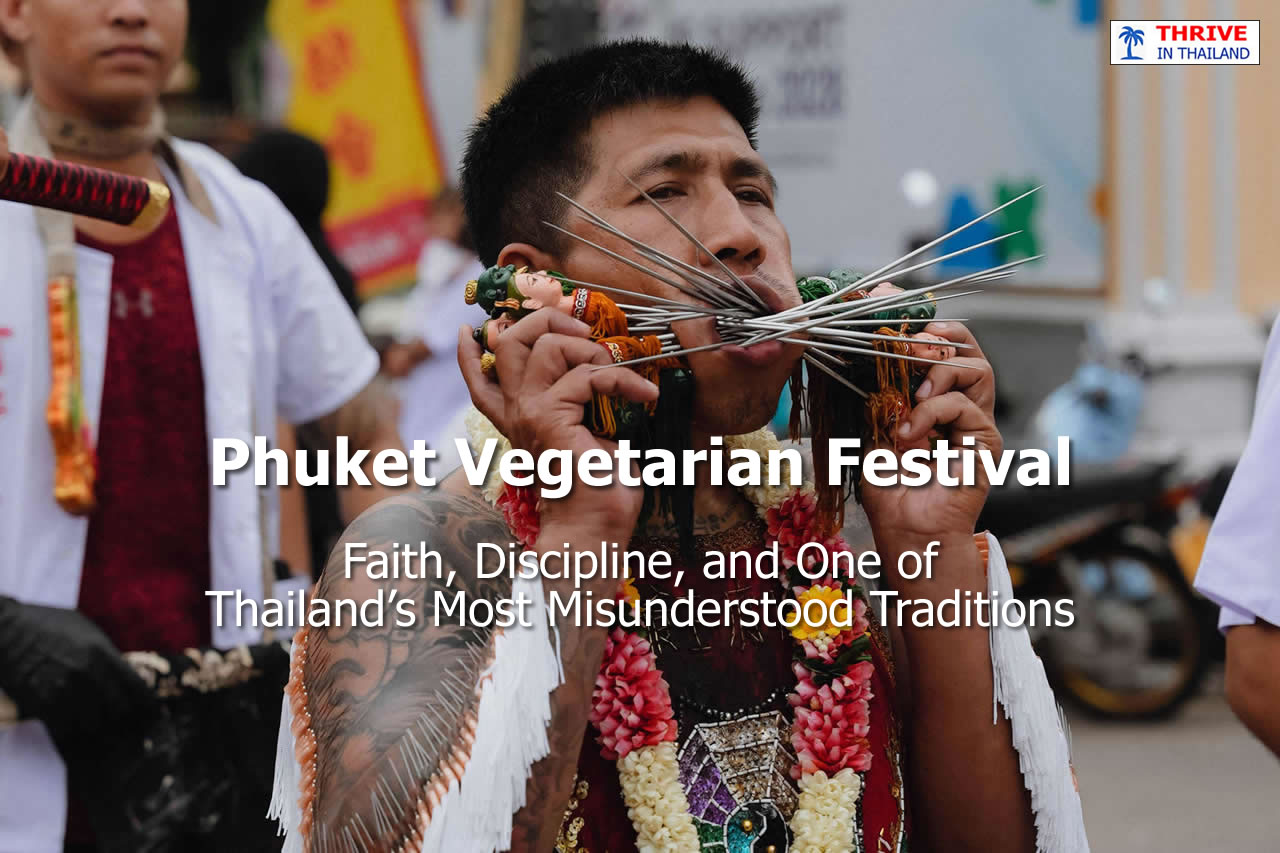
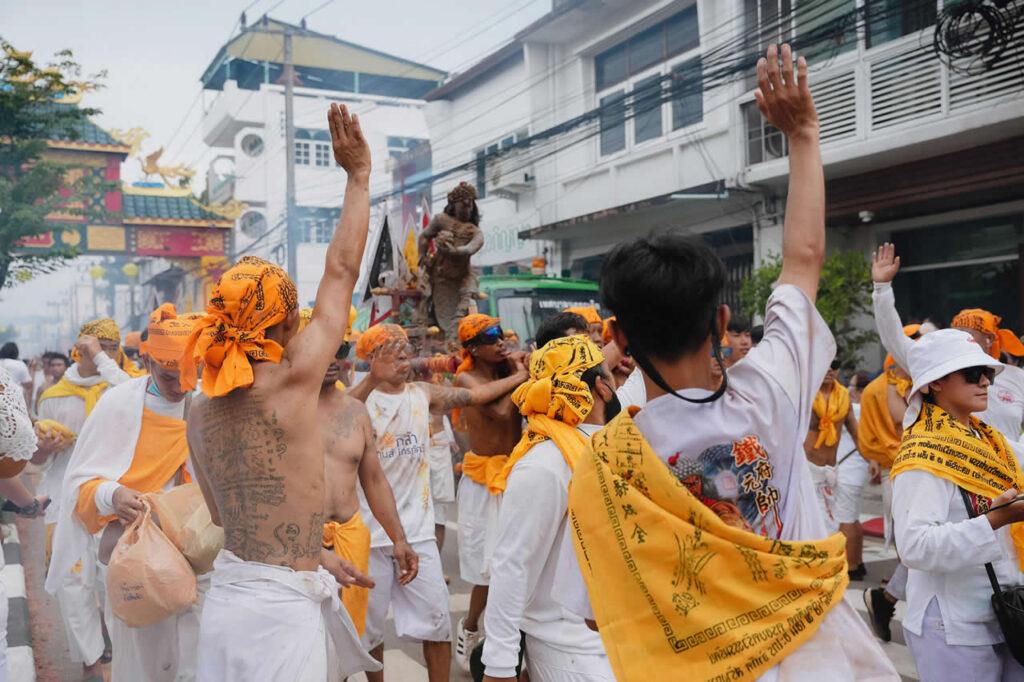
Every year, Phuket shifts into a very different rhythm. Shrines fill with incense, crowds follow processions through Phuket Town, and yellow flags start appearing everywhere, marking “jay” (vegetarian) food stalls and sacred spaces.
The Phuket Vegetarian Festival is often described online as something extreme or shocking, but that angle misses the point. At its core, this is a spiritual cleansing festival rooted in Chinese Taoist tradition, built around self-discipline, prayer, and a temporary way of living that’s meant to purify both body and mind.
Yes, some rituals can look intense to outsiders, and we’ll explain them clearly and respectfully. But if you understand the meaning behind the ceremonies, the festival makes a lot more sense. It’s not a performance for tourists! It’s a deeply important local tradition that brings communities together, especially around Phuket’s historic shrines.
In this guide, you’ll learn what the festival is really about, why it matters in Phuket, what visitors should expect, and how to experience it in a way that’s respectful and comfortable, whether you’re here for a short trip or living in Thailand long-term.
Festival at a Glance
This quick overview highlights the key facts and structure of the Phuket Vegetarian Festival at a glance.
| Festival Snapshot | Details |
|---|---|
| Duration | 9 days |
| When It Happens | 9th month of the Chinese lunar calendar (usually September–October) |
| Main Location | Phuket Town |
| Cultural Roots | Chinese Taoist tradition |
| Primary Purpose | Spiritual purification and protection |
| Key Symbol | Yellow jay flags |
| Food Focus | Strict vegetarian (jay) cuisine |
| Public Role | Observation and respectful attendance |
| Overall Atmosphere | Religious, intense, disciplined |
What Is the Phuket Vegetarian Festival?
The Phuket Vegetarian Festival is a nine-day religious event observed during the ninth month of the Chinese lunar calendar, usually falling in late September or October. It is rooted in Chinese Taoist beliefs and focuses on purification, merit-making, and protection from misfortune.
The festival is believed to have begun in Phuket in the early 19th century, when a traveling Chinese opera troupe fell ill while performing on the island. According to local accounts, the performers recovered after adopting strict vegetarian practices and conducting rituals in honor of the Nine Emperor Gods. When the illness subsided, the community credited the recovery to spiritual cleansing, and the tradition took hold.
Over time, the festival became deeply woven into Phuket’s cultural fabric, especially among families with Chinese ancestry. While similar vegetarian festivals are held elsewhere in Thailand, Phuket’s observance is the most prominent and visually striking, centered around long-established Chinese shrines in Phuket Town.
At its heart, the festival is not about spectacle. It is about restoring balance, avoiding negative actions, and showing respect to both the gods and the community. The vegetarian diet is only one part of that discipline, alongside prayer, ritual observance, and a conscious effort to live more mindfully for the duration of the festival.
What Makes Phuket Different?
A comparison showing how Phuket’s vegetarian festival differs from similar observances elsewhere in Thailand.
| Aspect | Phuket Vegetarian Festival | Other Vegetarian Festivals in Thailand |
|---|---|---|
| Scale | Largest and most prominent | Smaller, community-based |
| Shrine Network | Multiple historic Chinese shrines | Usually one or two shrines |
| Processions | Daily, town-wide | Limited or occasional |
| Ritual Visibility | Highly visible in public spaces | Mostly confined to shrine grounds |
| International Attention | High | Low to moderate |
| Cultural Role | Central to local identity | Primarily local observance |
The Spiritual Beliefs Behind the Festival
At the heart of the Phuket Vegetarian Festival is the belief that physical discipline leads to spiritual clarity. The festival is dedicated to honoring the Nine Emperor Gods, deities associated with protection, longevity, and balance in Taoist tradition. By observing strict rules for a limited period, participants believe they can cleanse negative influences and invite good fortune for themselves and their community.
During the festival, devotees follow a set of purification practices that go far beyond diet alone. These typically include abstaining from meat, alcohol, sexual activity, and behaviors considered harmful or disruptive. The idea is not punishment or deprivation, but temporary restraint as a way to reset both body and mind.
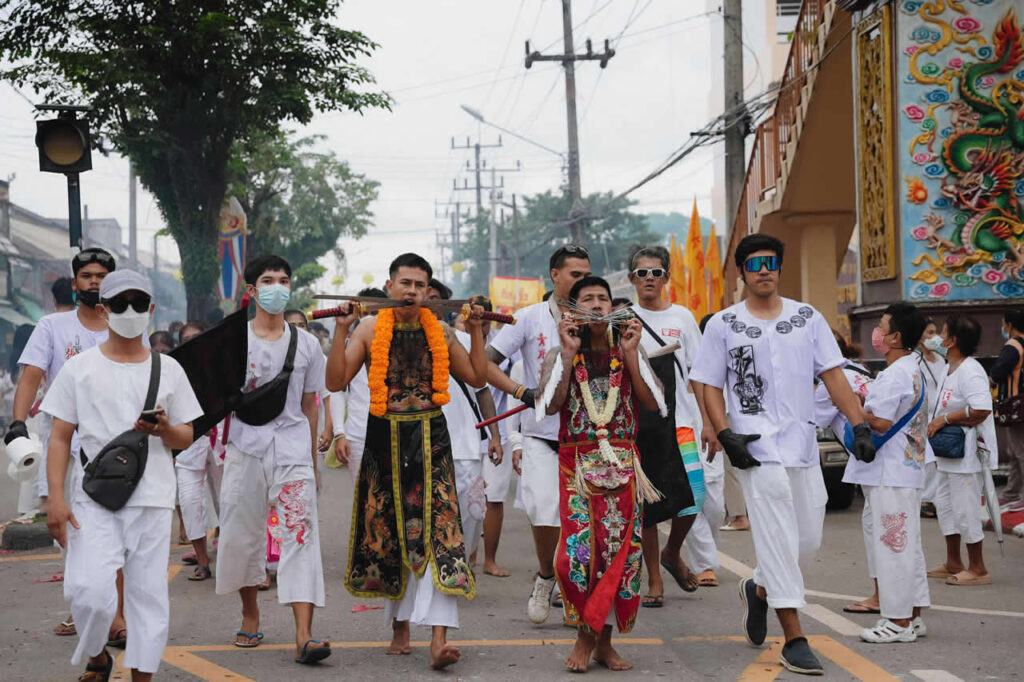
Prayer, incense offerings, and shrine ceremonies form the backbone of the festival. Participants visit Chinese shrines throughout Phuket Town to make offerings and seek blessings, often starting early in the morning. White clothing is commonly worn as a symbol of purity, while shrine spaces are treated with particular respect during the nine days.
One important distinction for visitors to understand is that not everyone involved is expected to follow the same level of discipline. Devotees, ritual participants, and observers each play different roles. While some individuals commit fully to all purification rules, others participate through prayer, food observance, or simply by showing respect during processions and ceremonies.
Understanding these beliefs helps put the festival into proper context. What visitors see on the streets is the visible expression of a deeply held spiritual system, one that emphasizes balance, intention, and collective well-being over spectacle.
Rituals & Ceremonies Explained
The rituals performed during the Phuket Vegetarian Festival are expressions of devotion and spiritual commitment rather than performances meant to impress or shock. Most ceremonies take place around Chinese shrines in Phuket Town and follow long-established traditions that are carefully overseen by shrine committees.
One of the most visible elements is the daily procession. Devotees move through the streets carrying sacred objects, visiting multiple shrines, and stopping for prayers and blessings. Firecrackers are often set off along the route, believed to drive away negative influences and clear the path for the procession. For residents, this noise and activity is an expected part of the festival’s rhythm.
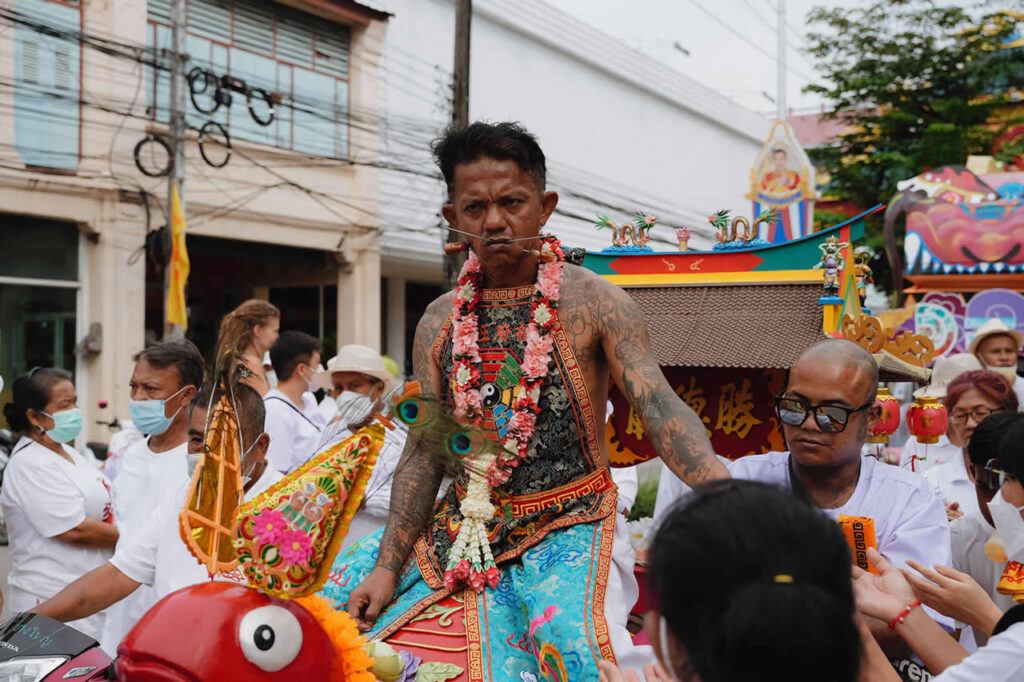
Another well-known aspect involves spirit mediums, locally referred to as mah song. These individuals are believed to enter a trance state during ceremonies, allowing them to act as vessels for protective spirits. In this state, they participate in rituals intended to absorb misfortune on behalf of the community. While these moments draw the most attention from outsiders, they are understood locally as acts of service and spiritual endurance.
Other ceremonies are quieter and less noticed by visitors. These include firewalking, blade ladder climbing, and extended prayer rituals held inside shrine grounds, often away from main streets. Food offerings, chanting, and incense ceremonies take place daily, reinforcing the spiritual focus of the festival.
It’s important to understand that participation in these rituals is voluntary and highly regulated. Only individuals who have prepared through purification practices are allowed to take part, and each shrine follows its own traditions and safeguards. For observers, these rituals are best viewed with distance and respect, recognizing that they carry deep meaning for those involved.
The Extreme Rituals: Why They Happen and How to Understand Them
One aspect of the Phuket Vegetarian Festival that cannot be ignored is the presence of extreme physical rituals, most notably those involving piercing and endurance. For many outsiders, these moments are confronting, confusing, or even disturbing, and it’s understandable to feel that way when seeing them for the first time.
These rituals are carried out by spirit mediums, known locally as mah song, who are believed to enter a trance state during the festival. Within this belief system, the trance allows protective spirits to act through the body of the medium. The physical acts performed during this state are understood locally not as self-harm, but as a form of sacrifice and protection, with the medium taking on suffering to absorb misfortune on behalf of the community.
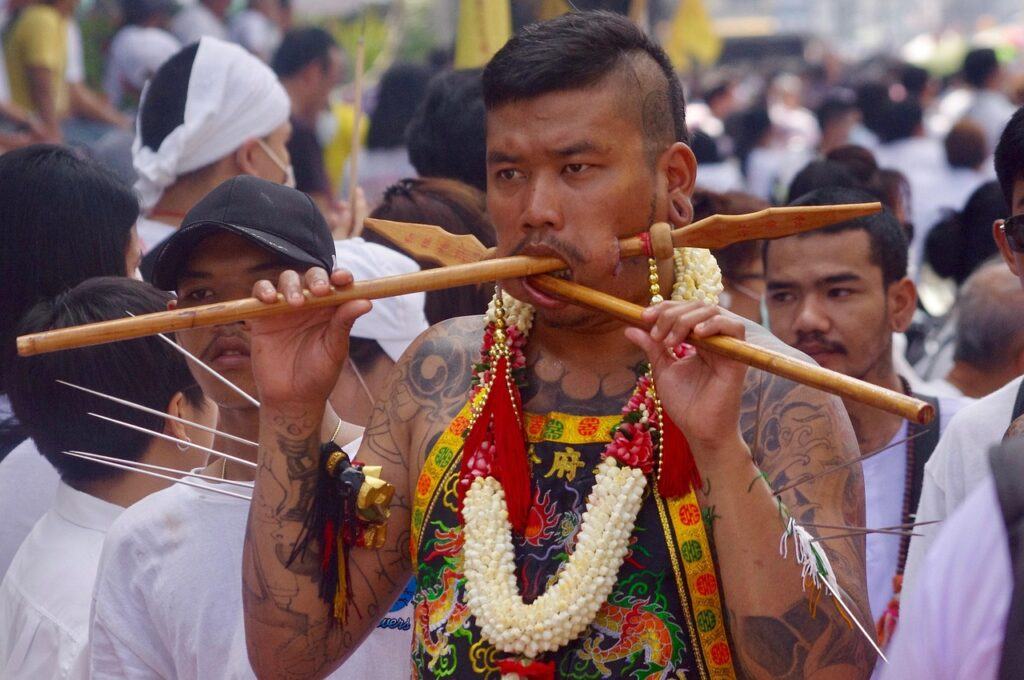
Importantly, these rituals are not spontaneous or uncontrolled. Participants undergo preparation through purification practices, and ceremonies are closely managed by shrine committees. The acts are performed voluntarily, within a structured religious framework, and with support teams present throughout the process.
For visitors, it’s important to approach these rituals with perspective. What may appear shocking through a modern or Western lens holds a very different meaning within the cultural and spiritual context of the festival. That said, there is no expectation for anyone to watch closely, photograph these moments, or remain nearby. Many observers choose to step back, observe briefly, or avoid certain processions altogether, and this choice is widely respected.
Understanding these rituals does not require agreement or comfort. It simply requires recognizing that they are acts of belief rather than spectacle, deeply rooted in tradition and community identity. Seen in this context, they are one element of a much broader festival centered on discipline, faith, and collective responsibility.
Where the Festival Takes Place
While the Phuket Vegetarian Festival is known across the island, its spiritual and cultural center is Phuket Town, where most of the historic shrines and processions are concentrated. This is where most of the historic Chinese shrines are located, and where the majority of processions, ceremonies, and daily rituals take place.
Key shrines form the backbone of the festival, each with its own schedule and traditions. Some of the most important ones include Jui Tui Shrine, Bang Neow Shrine, Limb Hu Tai Su Shrine, and Kathu Shrine. These locations act as gathering points for devotees, with processions often moving between shrines throughout the nine days.
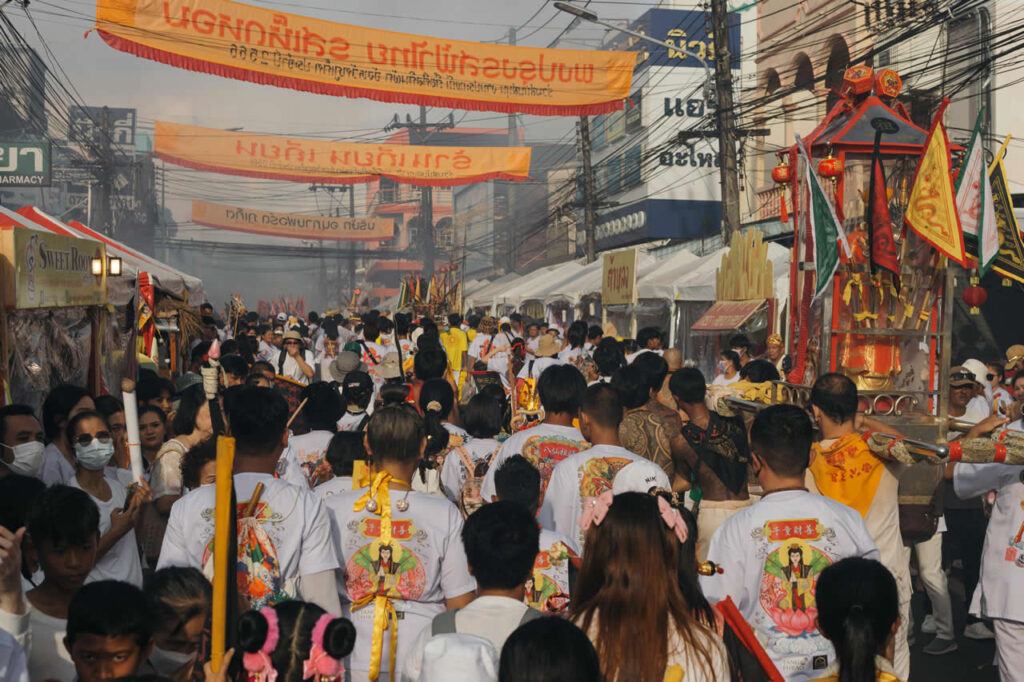
Outside of Phuket Town, smaller ceremonies may take place in local communities, but the atmosphere changes noticeably once you move toward beach areas such as Patong, Kata, or Karon. In those tourist-focused zones, the festival is far less visible, and daily life continues much as usual.
For visitors, this distinction matters. Those who want to understand the festival’s cultural depth will find it in and around Phuket Town, while travelers who prefer to avoid crowds, noise, and disruptions can base themselves elsewhere on the island and still visit selectively.
Knowing where the festival unfolds helps set expectations and allows visitors and expats to choose how closely they want to engage with the experience.
What Visitors Should Expect
During the Phuket Vegetarian Festival, daily life in parts of Phuket Town changes noticeably. Streets may close temporarily for processions, traffic can slow down, and loud firecrackers are common throughout the day, especially near shrine areas. For many locals, this is simply part of the festival atmosphere, but it can catch visitors off guard if they’re unprepared.
Crowds tend to gather early, particularly around major shrines and along procession routes. Mornings and early afternoons are often busier, while some ceremonies continue into the evening. Smoke from incense and firecrackers is constant near shrines, which may be uncomfortable for people sensitive to noise or air quality.
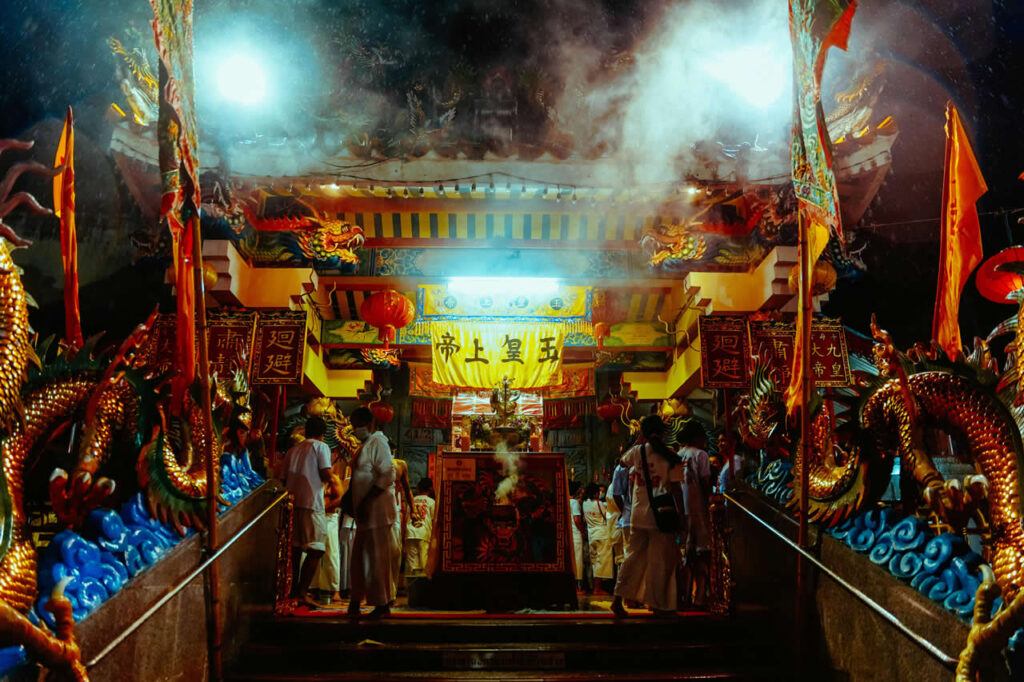
The overall mood is serious rather than celebratory. While there is food, movement, and activity, the festival is not a street party. Devotees are focused on prayer and ritual, and spectators are expected to observe quietly and keep a respectful distance.
Visitors should also expect practical disruptions. Some shops close temporarily, parking becomes difficult near shrine areas, and public transport may be rerouted. At the same time, vegetarian food stalls appear throughout the town, making it one of the easiest times of the year to find strictly vegetarian meals.
For many travelers and expats, the key is choosing how deeply to engage. You can observe a single procession, visit a shrine briefly, or simply experience the atmosphere from a distance. There is no expectation to participate, and respectful curiosity is generally welcomed.
Do You Have to Be Vegetarian to Attend?
No, visitors are not required to follow a vegetarian diet to observe or attend the Phuket Vegetarian Festival. The strict dietary rules apply primarily to devotees who have committed to the purification practices associated with the festival.
For those participants, eating jay food means more than avoiding meat. It also excludes ingredients such as garlic, onions, chives, and certain spices believed to stimulate the body. This stricter form of vegetarianism is meant to support spiritual clarity and self-restraint during the nine-day period.
Visitors and casual observers are free to eat as they normally would, especially outside shrine areas. That said, it’s considered respectful to avoid eating meat directly in front of shrines or during active ceremonies. Many people choose to eat vegetarian while attending processions simply as a gesture of respect, not obligation.
One of the most noticeable features during the festival is the abundance of yellow flags with red Chinese characters, marking jay food stalls and participating restaurants. Even for non-vegetarians, these stalls offer a unique opportunity to try traditional Thai-Chinese vegetarian dishes that are rarely available in such variety at other times of the year.
In short, participation is flexible. You can observe, sample vegetarian food, or simply learn about the festival without changing your routine. Understanding the distinction between devotees and visitors helps avoid misunderstandings and makes the experience more comfortable for everyone involved.
Is the Festival Safe for Tourists?
For most visitors, the Phuket Vegetarian Festival is generally safe as long as common sense and cultural respect are observed. Large crowds, loud noise, and heavy smoke are the main challenges, rather than any direct danger.
Ceremonies are organized and controlled by shrine committees, and ritual participants are experienced and prepared. Visitors are not expected to be involved in these activities and should avoid standing too close to active rituals or procession routes. Keeping a respectful distance is both safer and appreciated.
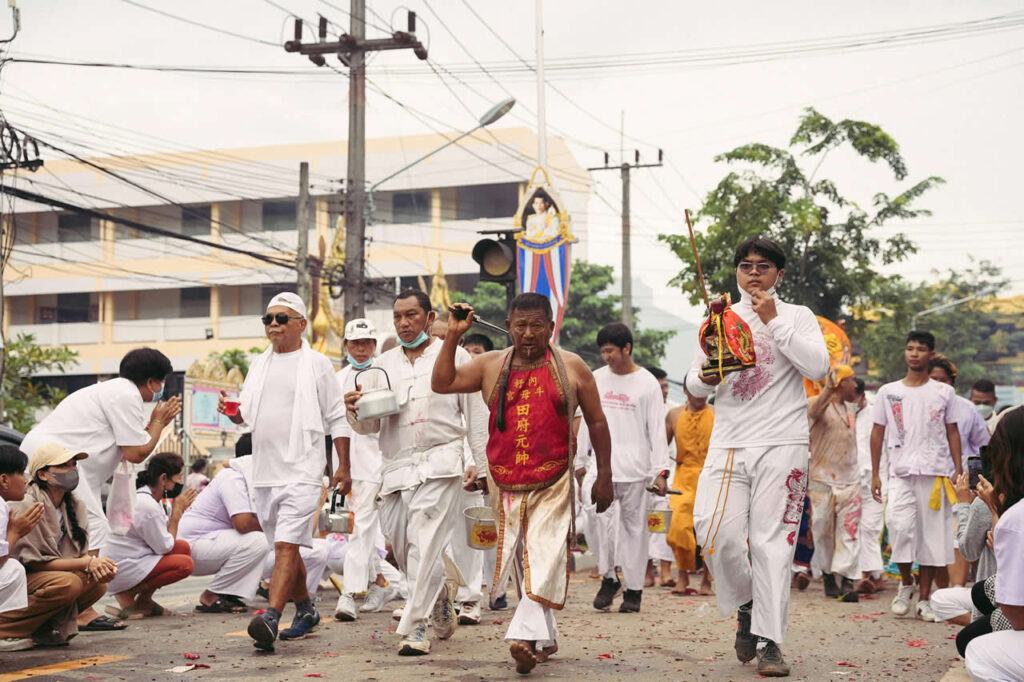
The biggest risks tend to be environmental rather than ritual-related. Firecrackers are frequently set off, sometimes without much warning, and streets can become slippery from ash, water, or offerings. Comfortable footwear and awareness of your surroundings go a long way.
Some people may find the festival overwhelming. The noise levels, smoke, and intensity of certain ceremonies can be uncomfortable, especially for children or those sensitive to crowds. In those cases, it’s perfectly reasonable to limit exposure or observe from quieter locations.
In short, the festival is not dangerous, but it isn’t a casual sightseeing event either. Approached with awareness and respect, most visitors experience it as a powerful cultural moment rather than something to fear.
Is This Festival Right for You?
This quick guide helps you decide how closely you may want to engage with the Phuket Vegetarian Festival.
| You May Appreciate This Festival If… | You May Want to Limit Exposure If… |
|---|---|
| ✅ You enjoy deep cultural experiences | ❌ Loud noise causes stress |
| ✅ You’re curious about religious traditions | ❌ Smoke affects your breathing |
| ✅ You prefer non-touristy events | ❌ Crowds feel overwhelming |
| ✅ You like observing local rituals from a respectful distance | ❌ You’re sensitive to intense imagery |
| ✅ You’re comfortable setting your own boundaries | ❌ You expect a relaxed sightseeing atmosphere |
Practical Tips for Expats & Travelers
A little preparation makes the Phuket Vegetarian Festival much easier to experience, especially if it’s your first time.
Dress modestly when visiting shrines or standing near ceremonies. Light, breathable clothing is best, and many locals wear white as a sign of respect, although this is not required for visitors. Comfortable, closed shoes are recommended due to firecracker debris and crowded streets.
Be mindful with photography. Taking wide shots of processions and shrine areas is generally acceptable, but close-up photos of ritual participants should be approached cautiously. If in doubt, step back or avoid photographing altogether. Flash photography near ceremonies is best avoided.
Plan your movements in advance. Traffic disruptions are common in Phuket Town during the festival, particularly around major shrines. Walking short distances is often faster than driving, and parking near shrine areas can be difficult.
If you’re sensitive to noise or smoke, choose your timing carefully. Early mornings can be quieter, while afternoons and evenings tend to be more intense. Bringing ear protection or a light face covering can make the experience more comfortable.
Finally, remember that observing respectfully is enough. There is no expectation to participate, donate, or follow festival rules beyond basic courtesy. A calm, observant approach is always appreciated.
Frequently Asked Questions
📌 Is the Phuket Vegetarian Festival unique to Phuket?
Vegetarian festivals are observed in other parts of Thailand with Chinese communities, but Phuket’s version is the largest and most deeply rooted. The concentration of historic shrines and long-established rituals makes Phuket’s festival distinct in scale and intensity.
📌 Can tourists actively participate in the rituals?
No. Active participation in rituals is limited to prepared devotees connected to specific shrines. Visitors are welcome to observe, visit shrines respectfully, and follow processions from a distance, but rituals themselves are not open to the public.
📌 Why are yellow flags used during the festival?
The yellow flags mark places that follow jay practices, including food stalls, restaurants, and shrine areas. Yellow is traditionally associated with purity and spiritual observance during the festival period.
📌 Is the festival appropriate for children?
This depends on the child. While many families attend, the noise, crowds, and intensity of certain ceremonies can be overwhelming. Parents should use discretion and choose quieter observation points if attending with children.
📌 Does the festival affect hotel availability or prices?
In Phuket Town, accommodations may fill up earlier and prices can rise slightly due to local travel and visitors attending the festival. Beach areas are usually unaffected.
Understanding the Festival in Context
The Phuket Vegetarian Festival is best understood not through individual moments, but through its purpose. For the local community, it is a time of restraint, reflection, and collective responsibility, rooted in traditions that have been observed for generations.
For visitors and expats, the festival offers a rare opportunity to witness a living religious practice rather than a staged cultural event. Approached with curiosity and respect, it provides insight into Phuket’s Chinese heritage and the values that continue to shape life in and around Phuket Town.
Not everyone will feel comfortable with every aspect of the festival, and that’s perfectly fine. Understanding where it takes place, what it represents, and how to observe it thoughtfully allows each visitor to decide how closely they want to engage.
Seen in this context, the Phuket Vegetarian Festival is less about spectacle and more about belief, discipline, and continuity, a reminder that Thailand’s cultural landscape is layered, complex, and still very much alive.
💬 Everyone experiences this festival differently. If you’ve observed it firsthand, your insights may be helpful to others—feel free to add them in the comments.